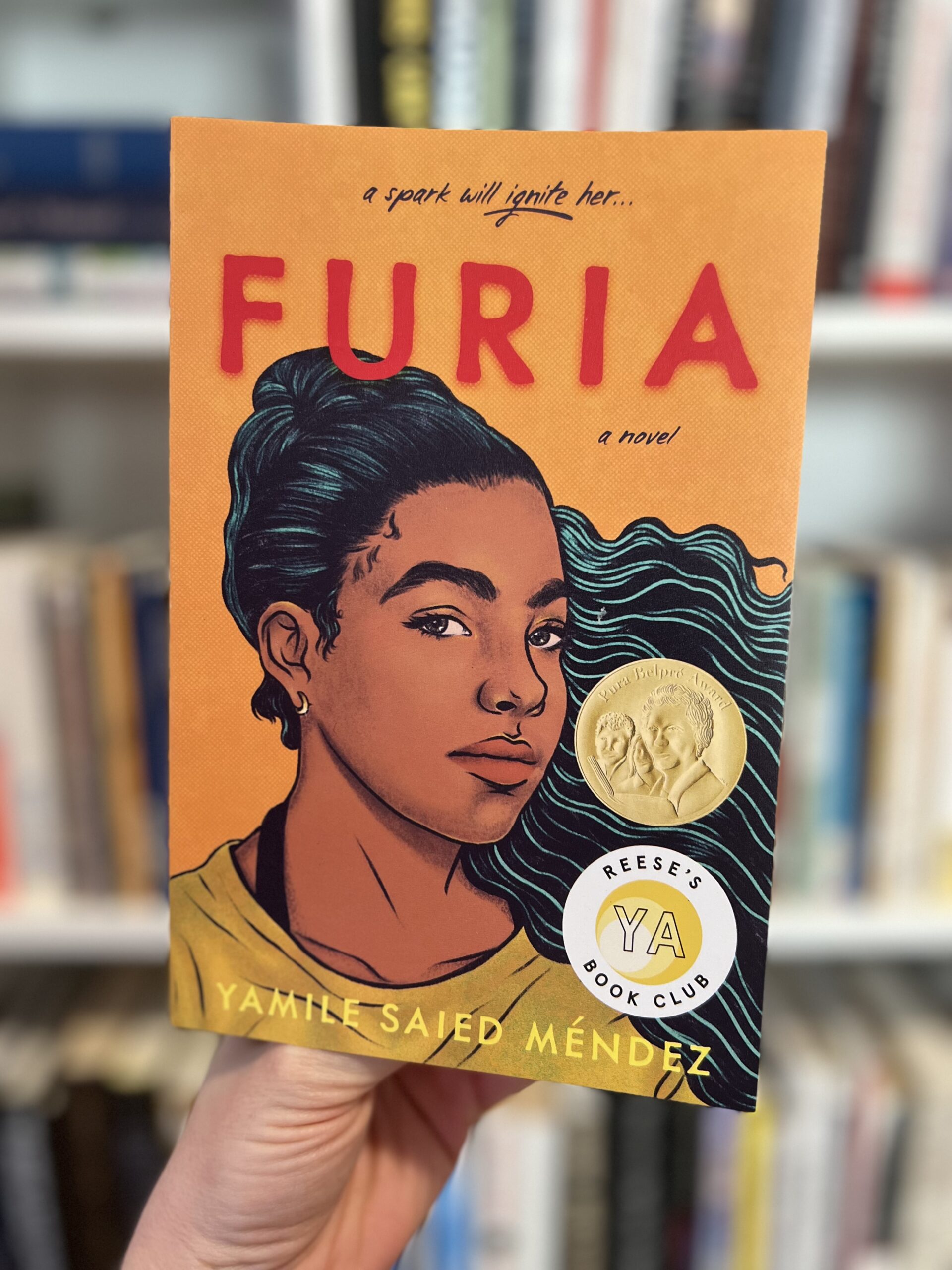
By Yamile Saied Méndez
“Scoring a goal is almost like kissing. The more you do it, the more you want. I wanted to keep scoring until it hurt.”
Summary
Furia follows seventeen-year-old Camila Hassan, a talented fútbol player growing up in Rosario, Argentina. At home, Camila is expected to be a good daughter, a good sister, and eventually a good wife. On the soccer field, however, she becomes La Furia, a fearless, fiercely competitive player who dreams of playing professionally.
There’s just one problem: her family doesn’t know she plays.
Camila’s father is volatile and abusive, her mother has absorbed many of the same expectations that restrict Camila, and her brother Pablo is the family’s celebrated soccer player. Camila is every bit as talented as he is, but she is a girl, and in her world that changes everything.
Then Diego Ferrari, Camila’s childhood love, returns to Rosario. Diego has become a professional soccer star in Italy, and suddenly Camila has to contend with something almost as complicated as her soccer career: deciding whether the life she wants is more important than the life other people want for her.
As Camila’s soccer team earns a chance to compete at a major South American tournament, her secret life becomes increasingly difficult to maintain. She must confront sexism, domestic violence, family expectations, love, and the possibility that becoming the person she wants to be may require leaving behind people she loves.
Quick Info
- Year of Publication: 2020
- Number of Pages: 368
- Awards/Nominations: Pura Belpré Award, Américas Award, Reese’s Book Club
Why I Chose to Read Furia
I played just about every sport as a kid, except soccer, thanks to a traumatic soccer-ball-smashes-face incident when I was a little tomboy playing with bigger kids. However, studying abroad in Paris during a World Cup renewed my allegiance to the sport, and seeing a men’s soccer game in Argentina woke me up to how beloved football is globally. I believe firmly in gender equity, and if there’s any sport where women prove “anything you can do, I can do better,” it’s this one. Also, sports are some students’ greatest passion. This is the first of many more YA sports books I want to read to hook students who might otherwise have no interest in reading.
Teaching Considerations
Audience: Booksellers list this as “14-18 years.” That seems like a sweet spot, but I wouldn’t hesitate to recommend it to young athletes for inspiration and adults who enjoy women’s empowerment stories. The book does include gender-based violence, domestic violence, and some sexual situations. All are authored with care and grace.
Key Themes: gender equity, female athletes, soccer, family, and first love.
Grouping Recommendation: Book club seems like a given, due to its inclusion in Reese’s Book Club. I also love this as an individual read in a sports book unit or in an Americas unit, where we explore the Americas beyond the USA.
Instructional Ideas:
CHARACTER
Through her alter ego, La Furia, Camila is allowed to be everything her family and society tell her she cannot be. So, learning to live as one whole, honest woman is perhaps the greatest challenge set forth in this book. Yamile Saied Méndez did a wonderful job creating this strong, complicated character, and surrounding her with so many antagonistic forces:
Her misogynistic, narcissistic father.
Her submissive mother, who can’t support her daughter without first learning how to love and take care of herself.
Her brother, an athletic competitor who has what Camila dreams of, takes it for granted in ways.
Diego, who is obsessed with fútbol like Camila, which complicates the couple’s future, despite their love.
Roxana, Camila’s best friend, whose family supports her athletic dreams.
Karen, the young girl at the church where Camila works, who looks up to Camila, putting new pressures on her.
STORY
While there are many emotional stories told in this book, the boldest seems to be the mother-daughter relationship. At the beginning of the book, we’re introduced to their relationship, and by the end of the book, that relationship and both women have completely changed. The generational healing portrayed is uplifting.
It’s impossible not to consider the importance of Camila’s relationship with Diego as well. One thing I love about this book is that it manages to create tension inside a wonderfully healthy relationship. Ultimately, this is a coming-of-age book about an athlete, but it wouldn’t have been as emotionally satisfying without the inclusion of Diego, Camila’s first love.
Key Excerpts
“My anger collapsed in on itself. Twenty years from now, would that be me? Would I be resigned to my fate, pushing my daughter toward the light so she could be free? Or pulling her down so I wouldn’t be alone in the dark.” – Page 223
Write a short story (1 to 3 pages) where a parent either pushes their child toward greatness, or holds them back. What was the child hoping to accomplish? Why might the parent have supported them or challenged their goal?
“One day, when a girl was born in Rosario, the earth would shake with anticipation for her future and not dread.” – page 296
How does Rosario shape this book? Did you notice or appreciate anything about the setting? What did you think of the inclusion of local societal views on the gender-based violence and murders taking place in the community? Did it support or distract from the narrative?
Book Talk Excerpt:
“Pobre Mamá.
I wished I could share my secret with her. But in spite of what my parents believed, I had learned my lessons. When I was twelve, my dad found me playing fútbol in the neighborhood potrero with a bunch of boys. I’d been having the time of my life…until he started bellowing at me in front of the whole barrio that he wasn’t raising a marimacho, that fútbol was for men. I took it in silence, ready to cry at my mom’s feet, but she sided with him. I hadn’t talked to her about fútbol since.
“Chau Ma.” I pecked her cheek and dashed for the door and freedom. “I’ll tell Mrs. Fong you said hi.”
“Answer your phone when I call you!”
My cheap phone was inside my backpack, safely out of credit. But she didn’t know that. “Chau, te quiero!” I threw her a kiss and ran out before she could stop me.
I paused for a half a second by the closed metal door of our apartment, but she didn’t say te quiero back.
The neighbor’s music, “Mi Gente,” set a reggaeton rhythm for my pounding feet. I took every shortcut between the cinder block buildings and shacks in 7 de Septiembre, our barrio. By the time I made it to the bus stop, I couldn’t hear the music anymore, but the pam-pam beat still resonated inside me.” – pages 5-6
I’m sure you’ve never lied or withheld information from your parents, right? There’s so much going on in Camila’s head, but so few of her thoughts and feelings are said out loud. Yamile Saied Méndez skillfully has us rooting for a protagonist who is not always honest. Compose a respectful, powerful argument in response to Camila’s father’s actions and words in the excerpt above. Or, if you agree with him, compose a respectful, powerful argument that explains why.
My Thoughts and Reflections
★★★★★
I enjoyed this book. Being the mother of two daughters in a family full of women might make me biased, but I’m a sucker for any story that champions gender equity. Also, I read this book during the 2026 Men’s World Cup. It made me want to take my daughters to a 2028 Women’s World Cup game…
Topics/Ideas/Books/Authors I’m Curious About As A Result of Reading Furia
I’d love to read a bunch of YA sports books! The Running Dream, Medicine Wheels, Heat, Ghost, The Crossover, Hoops, Gym Candy, and the anthology, Game On, seem like great starting points.

Leave a Reply