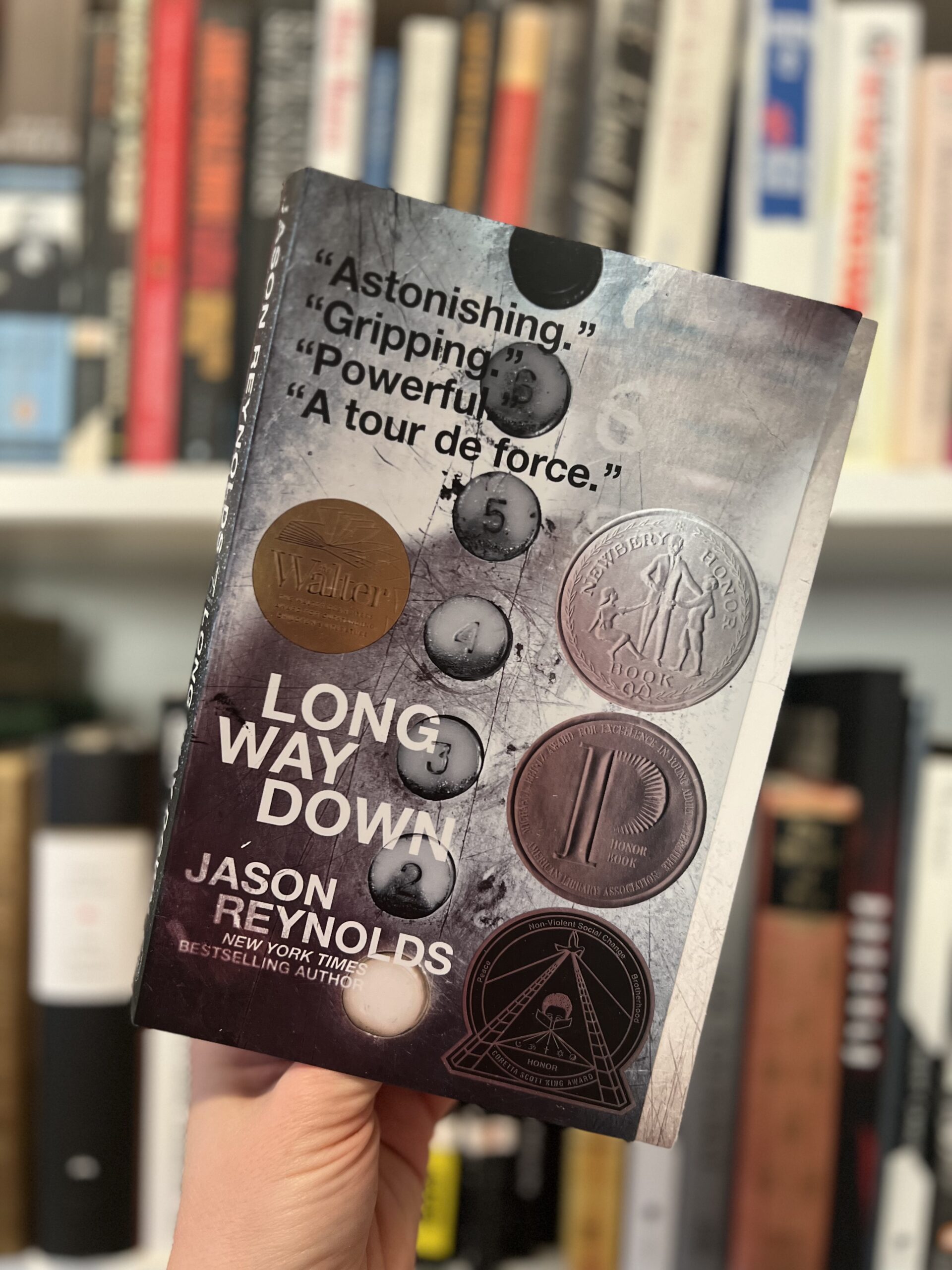
By Jason Reynolds
“ANOTHER THING ABOUT THE RULES
They weren’t meant to be broken.
They were meant for the broken
to follow.”
Summary
When fifteen-year-old Will loses his brother Shawn in a shooting, his first inclination is to “follow the rules” of his neighborhood, take his brother’s gun, and hop on an elevator en route to vengeance. What follows is an incredible, lyrical, and psychological ride with ghosts, who force Will to slow down and think hard about his next move. This staggering novel in verse confronts modern gun violence without judgment or fear.
Quick Info
- Year of Publication: 2019
- Number of Pages: 336
- Awards/Nominations: Michael L. Printz Honor, Newbery Honor, Coretta Scott King Author Honor, Walter Dean Myers Award winner, National Book Award Longlist, Edgar Allan Poe Award winner
Why I Chose to Read Long Way Down
Having lived in a house with a sweeping view of Columbine High School from my backyard in 1999, it’s hard not to be curious about gun rights in the U.S.A. I picked up this book hoping to diversify my perspective on national viewpoints. Long Way Down addresses gun violence and has strong critical acclaim.
Teaching Considerations
Audience: Booksellers list this as “ages 12 and up.” The book has next to no profanity. It navigates violence in society with grace, avoiding graphic details. It’s a quick read and relatable for teens who are beginning to really embrace autonomy in big and small life decisions.
Key Themes: cycles of violence, trauma, masculinity, community, and choice vs. destiny.
Instructional Ideas:
STRUCTURE
Long Way Down is a structural masterpiece. The elevator floors serve as a mechanism to introduce new characters, press down deeper into Will’s history, and keep readers rooting for Will to prove he’s not an “L” button loser. For 230 pages, the ticking seconds add up to a single minute, keeping readers engaged.
CHARACTER
Who is Will? Why do we root for him? Which of his flaws does this text take a magnifying glass to? What tools does the author use to flesh out this character?
TWISTS
With every new floor traveled and character introduced, the author pulls readers in closer by revealing shocking, heartwrenching details about the characters, the story, and the plot.
THE ENDING
Why might an author end a book with a question instead of a rigid conclusion?
*Note: The back of this book includes a great reading group guide from Simon & Schuster.
Key Excerpts
“Shawn.” – page 12
A single word on an otherwise empty page, sealed with a period, to show gravity.
“THANK YOU
THANK YOU
THANK YOU
THANK YOU
THANK YOU
THANK YOU
THANK YOU
HAVE A NICE DAY” – page 24
Repetition as an emotional force.
“A WARM SENSATION” – page 230
The protagonist’s lowest point.
“this cell
this coffin
this elevator“ – page 302
One of many lessons in symbolism. (Will, Pop, the middle drawer, the “L” button, smoke, beef, etc.)
My Thoughts and Reflections
★★★★★
This was a quick, heartwrenching read. I enjoyed the rythm of the book and the creativity of its thoughtful structure. I also appreciate its universal message to young adults about the difficulty and necessity of choosing the best path forward for yourself, despite peer, family, society, and generational pressures. It’s an emotional read with a shocking ending that’s guaranteed to get students thinking and (hopefully) talking. I see this as an important text, one that will open the conversation about gun violence in schools the U.S.
Topics/Ideas/Books/Authors I’m Curious About As a Result of Reading Long Way Down
I want to read more of Jason Reynolds’ work! Many of his books are critically acclaimed, which doesn’t surprise me after finishing Long Way Down. He writes deep, thought-provoking stories for young people, and often teams with illustrators for graphic collaborations, such as Stuntboy and Spider-Man.
I’d also be interested in reading more YA books that address gun violence from different perspectives. If there was anything that would make me hesitate to make teaching an occupation, it’s school shootings. However, I have two kids in school, and how can I expect them to attend while I hold tight to debilitating fear?



Leave a Reply