
By Ben Philippe
“‘It doesn’t not matter and we both know it.’
She echoed the exact words he had once said to her.”
Summary
Norris Kaplan, a Black French-Canadian, is forced to relocate from Montreal to Austin, Texas, when his single mother accepts a new professorship. As a junior dropped into an unfamiliar U.S. high school, Norris plans to keep his head down, survive day by day, and return to Canada after graduation. However, his sharp wit and reflexive sarcasm make invisibility impossible, pulling him into unexpected friendships, conflicts, and romantic entanglements. As his assumptions about American culture are challenged, Norris must decide whether to cling to cynicism as a defense mechanism or risk letting his guard down and enjoying his life.
Quick Info
- Year of Publication: 2019
- Number of Pages: 372
- Awards/Nominations: William C. Morris YA Debut Award Winner
Why I Chose to Read The Field Guide to the North American Teenager
I was curious about the global perspective. What do Canadians think of their neighbors in the USA? What would the high school students in this Texas school think about the Canadian protagonist? Further, I’m a sucker for humorous writing, and I wanted to know if/how the author would push past Hollywood teen-movie stereotypes.
Teaching Considerations
Audience: Booksellers list this as “ages 13 and up.” There are more than a few places where the humor feels most appropriate for an older, hormonal, teen male audience. Lots of profanity. Parents might have complaints. Ultimately, the book’s message is so loud it drowns out the honest, messy teenage reality it portrays.
Key Themes: identity and self-construction, nationality, outsiders, stereotypes, vulnerability, cynicism, friendship, and belonging.
Instructional Ideas:
CHARACTER
This is where the book really showed its strength. The author did a great job breaking down stereotypes in this book. From Canadian self-deprication transformed into self-confidence, to questioning U.S. supremacy, to humanizing bullies, loners, and cheerleaders, normalizing platonic relationships between straight and gay friends, and treating divorced parents with empathy.
STRUCTURE
The top of each chapter includes a title and a short excerpt that aligns with the field-guide style, which ties in nicely with the literal field guide that Norris carries and writes in, which ultimately leads to his downfall.
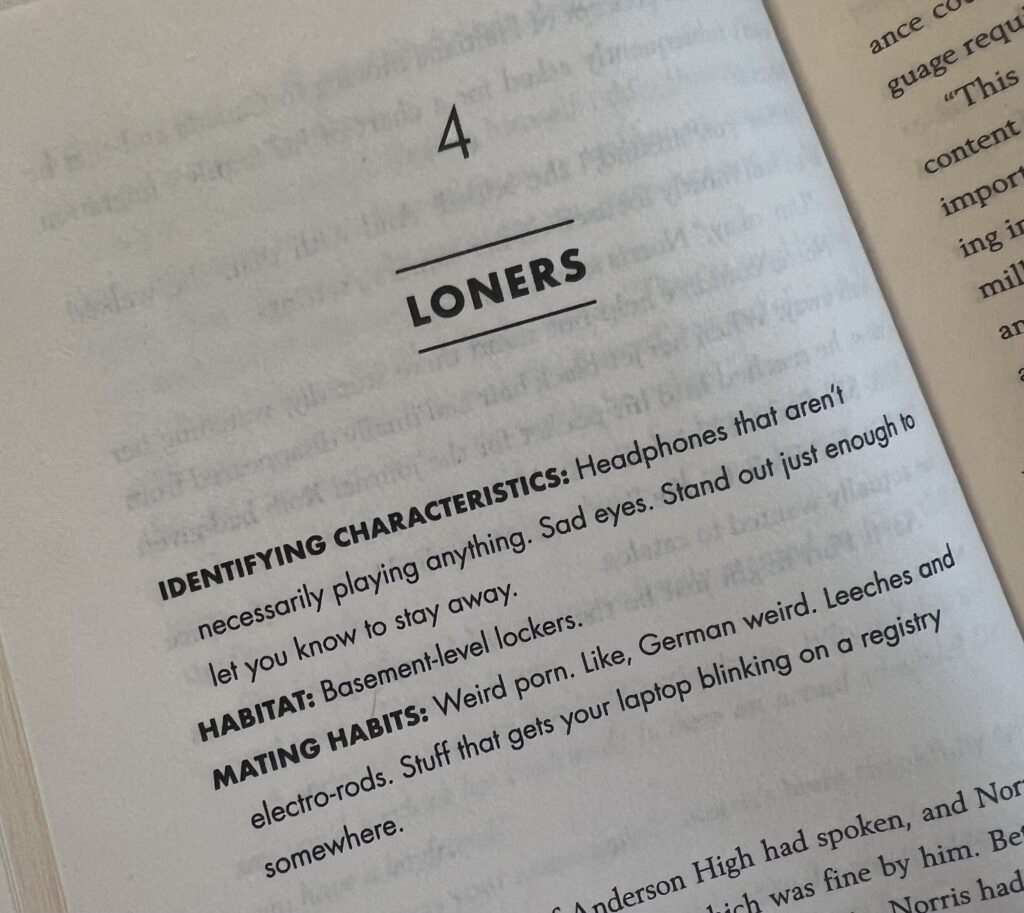
HUMOR
The comedy in this book is perfect for a teenage audience, and as we get to know the protagonist and his entourage, and his cynicism decreases, it’s easier to empathize and just enjoy every joke. Plus, Norris consistently proves, through his actions, that he’s a good person and an advocate for others, despite his tendency to tell off-the-wall jokes.
THE ENDING
This book has a perfect comedic ending that I won’t spoil here, except to say it’s surprising and a great reminder of what’s most important for Norris’s journey. To paraphrase his father in the book, everyone messes up. It’s what we do with the mess that matters.
Key Excerpts
“…the eh thing bothered him more than he cared to admit. If he was going to be known as “The Canadian” whatever he did, he might as well be an honest Canuck. Bridges were easier to burn down than to build anyway.” – page 29
What assumptions do students at Norris’s high school make about him? Why?
“‘Ha! I knew it!’ Norris exclaimed. ‘We’ve got ourselves one Madison. Do we have an unplanned pregnancy next?’
Norris could swear he saw Madison—the one actually named Madison—stifle a smile.” – page 30
“Aarti had picked him up in a dark blue Honda, obviously borrowed from her parents for that evening…Immigrants, his own parents included, had a way of always opting for the safest, most average option. The best way to fit in to this land whose roads they were borrowing.” – page 139
What assumptions does Norris make about the students at his new, U.S. high school? Why? Is he correct about Madison? Aarti? Liam? Patrick? Does the book dispel all of these assumptions in the end?
“Spring at the Bone Yard came with yet another tradition, something Austin had no shortage of between UT Longhorns gear, the music festivals, and annual film events that peppered downtown. In this instance, apparently, it all came down to key lime pie.“ – page 191
Place as a character. What was surprising to learn about this book’s setting? Do you feel like you know the place well after reading this story? Why was Austin, Texas, integral to this story?
“‘You’re not a handsome blue-eyed little Ken doll who’s going to get a slap on the wrist every time he messes up. That, tonight?’ she said, pointing to the door. ‘Do you know what that was? Do you?!’
‘I-‘
‘That was a fucking coin flip, Norris.’“ – page 319-320
Earning the lessons embedded in an author’s text. Why does this scene come across as emotionally sound? Why does it move us instead of feeling preachy or unearned?
My Thoughts and Reflections
★★★★★
I didn’t start really loving this book until about halfway through, when I understood Norris’s character better. Some of his horney, teenage humor turned me off at first. Ultimately, I appreciate that this book doesn’t condescend or attempt to pretend that young adults are all completely moral and virginal. I could see high schoolers enjoying the humor and feeling like this book is written for them, by a writer who gets them. The text manages to cover some really heavy topics (suicide, police brutality, divorce) with grace and wit. The themes of acceptance and self-confidence shine in the final chapters, where each character arc settles, boldly, sometimes unexpectedly, and at other times, perfectly expectedly.
Topics/Ideas/Books/Authors I’m Curious About As a Result of Reading The Field Guide to the North American Teenager
I’d love to continue getting global YA perspectives with big and small opinions about U.S. society: Americanah, Born a Crime, I Am Malala, etc. Many years ago, I was encouraged to look at news articles about 9/11 from different countries. It shocked me to see how different nations experienced this event. Some spurned the violence, some celebrated it. Instead of unquestioningly believing in American exceptionalism, I want an honest outlook. What are our strengths as a nation? Where might we improve?



Leave a Reply