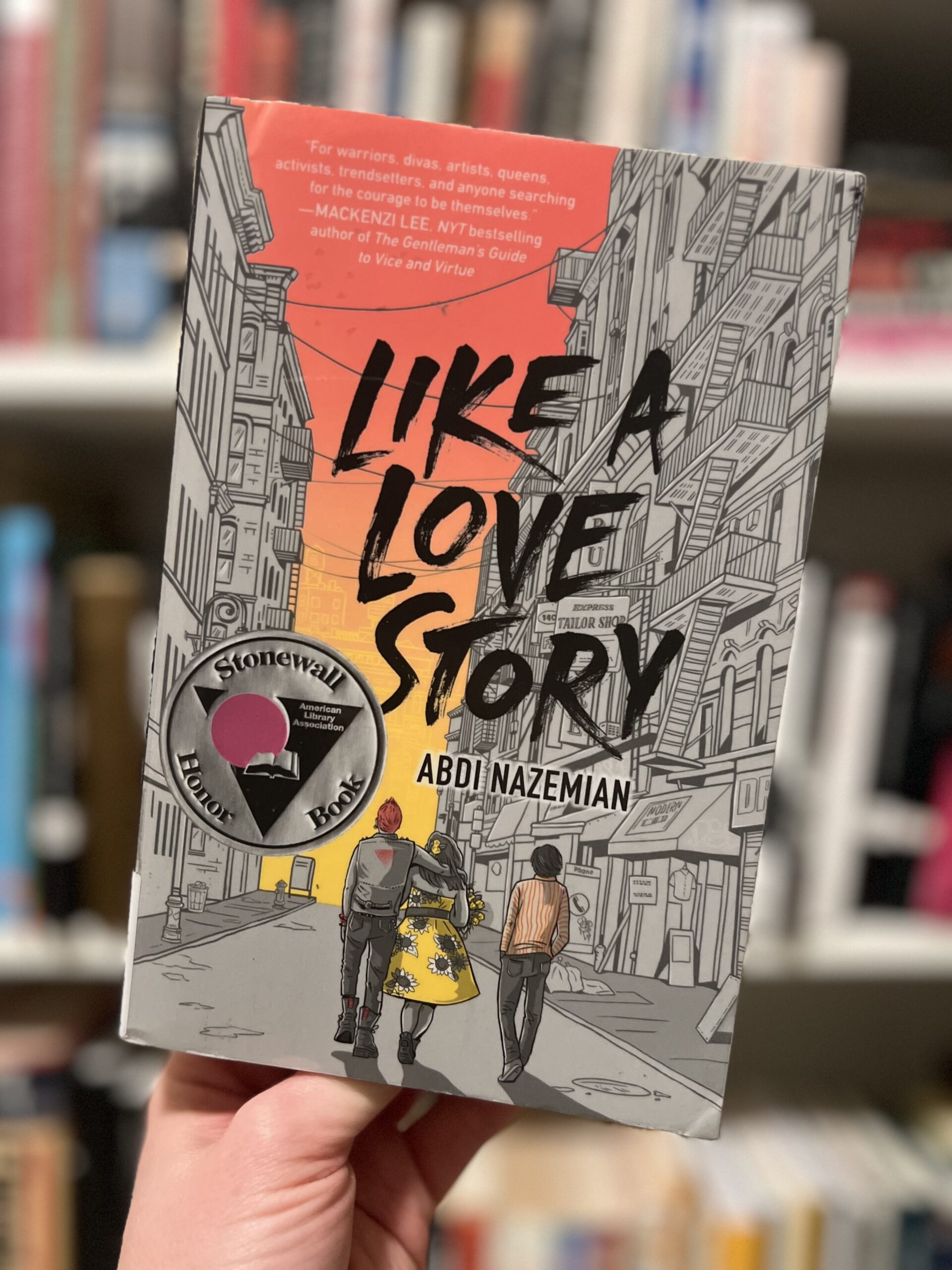
By Abdi Nazemian
“It’s the irony that hits me first. That I have never felt more alive, while I’m surrounded by people who are dying.”
Summary
Like a Love Story is about three friends in New York City during the height of the AIDS crisis, who navigate high school, family, sexuality, love, and the impending death of Uncle Stephen, an activist and eternal force of love. The book begins with an awkward love triangle between Art, an openly gay photographer activist, Judy, a confident fashion designer and advocate, and Reza, a closeted Iranian immigrant new to the city, who desperately seeks to find himself and what he wants somewhere inside it. Along the way, Uncle Stephen and Madonna’s voices and advocacy counteract any heartbreak and hatred, and bond the trio for life.
Quick Info
- Year of Publication: 2020
- Number of Pages: 413
- Awards/Nominations: Stonewall Book Award, Time Magazine Best YA of All Time
Why I Chose to Read Like a Love Story
I lived in NYC for several years and have been in love with it ever since. That’s probably the first reason I picked up this book. From the book blurb, I also gathered that it touches on topics that are important to me: immigrants, LGBTQ+ rights, and activism.
Teaching Considerations
Audience: Booksellers list this as “ages 13+.” The book dives into very heavy subjects with grace and helpful, explicit clarity. Sex and romance scenes are written with class. It touches on death, AIDs, safe sex, homophobia, bullying, and contains some profanity.
Key Themes: queer identity, cultural identity, acceptance, activism, chosen family, family, the AIDS crisis, love, pop culture.
Instructional Ideas:
CHARACTER
This book could be a master class in distinct character voice! Of course, I listened to a portion of it via audiobook, so I might be biased. The author does a great job of solidifying the narrators’ points of view in each chapter.
STRUCTURE
Broken up by three narrators (Reza, Art, and Judy) and a few “notecard” entries by Uncle Stephen, this story is told chronologically and powerfully, keeping readers engaged and guessing.
HISTORY
Let me preface this with: I love Like a Love Story, the premise and the execution.
The 131 notecards Stephen authored were an incredible asset for including and honoring LGBTQ+ history.
There were places where this book felt written by an author living in 2019 due to word selection, in-depth knowledge of the repercussions of the Reagan presidency, and the inclusion of a Lady Gaga quote. At times, it really felt like the author was saying, “See this? Not enough has changed, has it?”
The Author’s Note at the end of the book explains how Abdi Nazemian did his best to adhere to historical events but adjusted a few things for the sake of storytelling. He also closes that note with the most wonderful statement:
“When people say that history repeats itself, they tend to mean it in a negative way. But there is so much that can be good about history repeating itself. Activist movements can learn from past activism. Storytellers can be inspired by artists who speak to them. Families and communities can honor their ancestors.”
Key Excerpts
“Now I worry, and I search his finger for any sign of a hangnail. If his hangnail touched my hangnail, and he has AIDS, which he probably does, then I have AIDS, and I have destroyed my mother’s life.” – page 103
Part of what creates hysteria is the unknown. The author did a great job narrating this book by people with different levels of understanding of AIDS, from fearing it to having it. Can you point to examples in this book where explicit clarity of information about AIDS might ease anxiety in readers first learning about it?
“My mom says homosexuality is luckily a problem that Iranians don’t have.” – page 12
“If he went back to Iran, they’d kill him.” – page 288
“…you must understand we come from a culture with no history of this. [Your mother] hasn’t been exposed to people like you, or to gay rights. I’ve been living in New York for a decade. I’ve met people, seen things. She needs time.” – page 391
In so many places in this book, queer identity and cultural identity clash. How does the author reconcile this without rushing to judgment? How do Reza and his family navigate this? Do you feel like you got enough context about the Iranian Revolution to better understand Reza and his family? Why?
Book Talk Excerpt:
“#76 Madonna
She is not ashamed, and therein lies her massive power. Because shame is their weapon. People who feel shame remain hidden, and that’s exactly how they want us. And then along comes Madonna…I don’t know if shame has a true opposite—perhaps pride, but that doesn’t feel quite right. So, as far as I’m concerned, the opposite of shame is Madonna.” – page 331
Madonna becomes a source of faith for this unconventional trio. Which pop culture icon gives you faith? Why? How have they inspired you to push forward during challenging times in your life?
My Thoughts and Reflections
★★★★★
I loved this book from start to finish. I learned so much about what challenges gay men might encounter while coming of age, regardless of the time period, as gay rights are still not globally accepted as human rights. This book provided me with a lot of clarity, information, and history about AIDS. I also gained a greater perspective on what it might look, sound, and feel like being an immigrant in a U.S. high school. The way the author wove the stories of the narrators together, including each unique family story, was brilliant. I wanted to cry happy tears when Abbas supported Reza and to rage-bawl when Stephen’s mother didn’t show up on his deathbed. Part of me thinks this story could only have been told in New York, but Judy (a character I LOVE for her strength and self-confidence) visiting Paris and meeting up with activists there, too, reminds me that the truth is, the AIDS crisis was and is universal. I would recommend this book without hesitation.
Topics/Ideas/Books/Authors I’m Curious About As A Result of Reading Like a Love Story
In my opinion, the author did a great job of including only the information necessary about Reza’s immigration from Iran to tell this particular coming-of-age story. It was that information that sparked my interest in Ayatollah and the revolution he sparked when returning from exile. I’d like to read a book written by an Iranian theocratic supporter to get my bearings on a wider scope of experiences and opinions. I wonder what parallels (if any) there are between conservatives in the U.S. and conservatives in Iran. In the Rose Garden of the Martyrs: A Memoir of Iran (a patchwork of viewpoints) and One Woman’s War: Da (widely read inside Iran) might support my curiosity here.

Leave a Reply