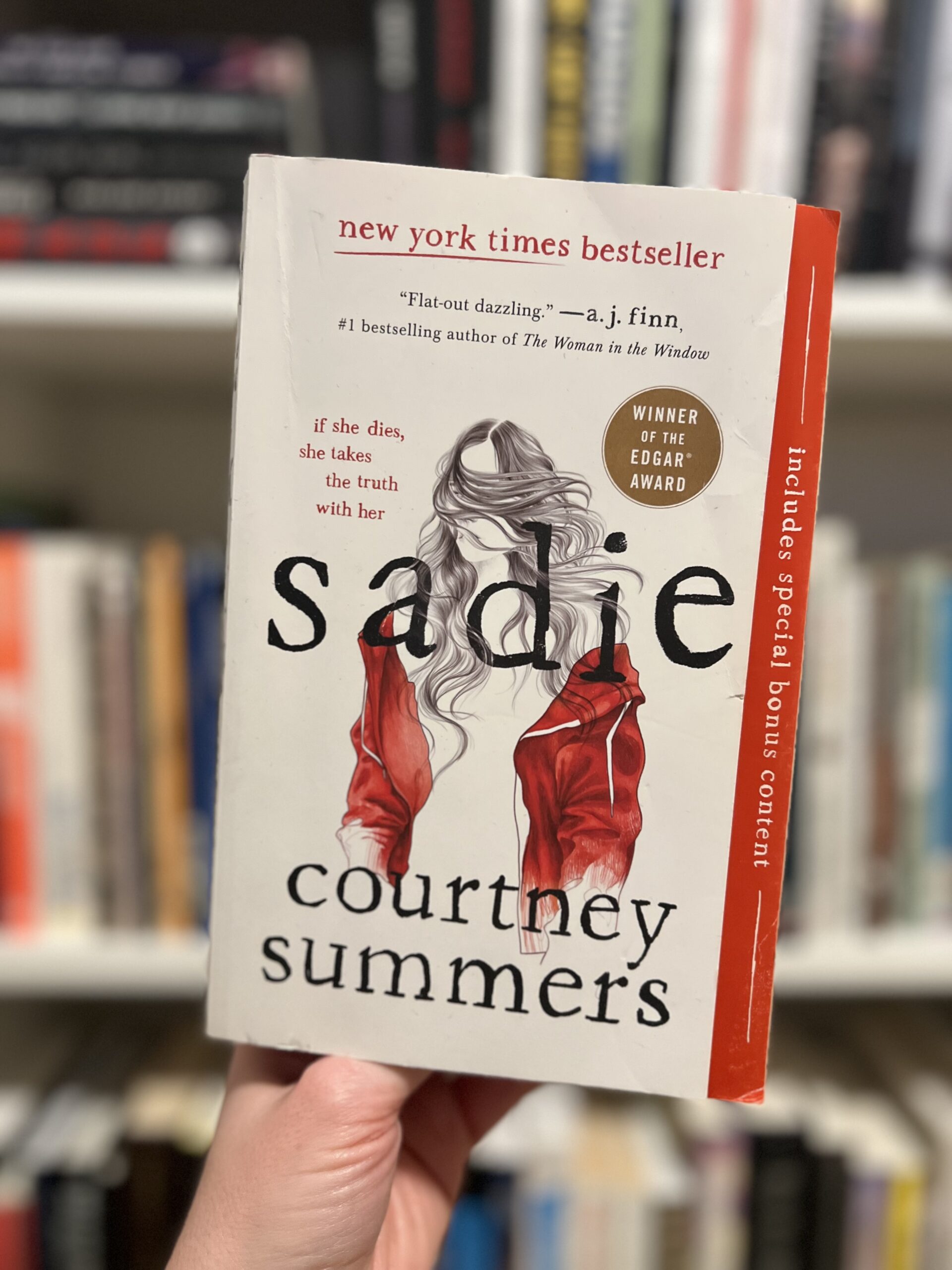
By Courtney Summers
“‘I’m going to kill a man.”
Summary
This book is about Sadie Hunter, a nineteen-year-old woman on a mission to find and kill the man who violently murdered her thirteen-year-old sister, Mattie, who was more of a daughter to her, as their mother was a mostly absent drug addict. Sadie’s story is told through personal narration and secondhand through a podcast narrated by media personality West McCray. From the day Sadie leaves her trailer, we watch her move from town to town, person to person (rich, poor, and down on their luck), threatening anyone she must with her switchblade.
Quick Info
- Year of Publication: 2020
- Number of Pages: 336
- Awards/Nominations: Edgar Award, Odyssey Award, John Spray Mystery Award, Cybils Award, Audie Award, White Pine Award, Goodreads Choice Award
Why I Chose to Read Sadie
I’m not a true crime fanatic, but I’m sure many students will be.
I read this book blurb immediately after the one for Long Way Down, and I found it interesting that both were stories about a sibling seeking vengeance in a violent world. After reading both, I’m shocked at how different the books are.
Also, I saw the story was set in Colorado, and I figured that, if it drew me in, it might also interest students. However, all the locations in the book turned out to be fictional. I’m not certain why the author chose this state, to be honest.
Teaching Considerations
Audience: Booksellers list this as “ages 13-18 years.” This age range feels about right. The book includes vengeance, violence, drug use, underage drinking, and profanity. Of course, as the book explains, the victims of these crimes tend to grow up faster. I’m curious whether reading this book might inspire a very young person to seek help sooner. There’s a ten-year-old, Nell, who experiences abuse and winds up in therapy by the end.
Key Themes: vengeance vs. justice, child sexual abuse, LGBTQ+ identity, voice, popular media, true crime, poverty, and female rage.
Instructional Ideas:
CHARACTER
The author effectively embodied dozens of characters, using the podcast format. All characters were presented with distinct voices and points of view to serve the narrative. Sadie’s dead sister Mattie haunted every page.
STRUCTURE
Sadie really shines here! (See the Book Talk Excerpt below for more.)
MYSTERY
Almost none of the twists in this book really jarred me. From page one, the author sets readers up for the horrible, compelling predictability of what’s to come.
What might keep readers invested in this story is Sadie’s drive and audacity. She consistently flings herself into danger, making bold decisions and taking action like so many victims of sexual abuse wish we could. Not even the vengeance, necessarily, just having the capacity to speak up and say/do anything about it.
ENDING
Here is the one twist that jarred me. I did not expect this ending, but the more I think about it, the more I like it. The author’s choice to let readers invent their own ending for Sadie is a strong one. It makes the vengeance less concrete, allowing the book to serve justice in a way that more specific violence and true crime indulgence never could.
Key Excerpts
“My m-mom’s d-d-d—” – page 12
Why do you think the author created a protagonist with a stutter?
“Last thing she said to me, my face cupped firmly in her hands, was, Whatever you’re thinking, you get it out of that damned foolish head of yours right now. Except it’s not in my head, it’s in my heart, and she’s the same woman who told me if you’re going to follow anything, it might as well be that.” – page 14
How might this whole book be a testament to following one’s heart? What’s the difference between justice and vengeance? Does Sadie get vengeance or justice?
“‘I creep down the hall and find the bathroom. I push the door open and take a shocked step back.
‘G-get out!’ a girl yells. ‘I w-want y-you t-to g-get out of h-here!’
She’s eleven, naked in the tub.” – page 130
In a handful of occasions throughout this book, the author delves into PTSD-inspired memories. How effective are these? Why? What perspective are they told in? How do they push the story along and/or get us to root for the protagonist?
Book Talk Excerpt
“Today, we’re doing something new—something big. Today, we’re pre-empting your regularly scheduled episode of Always Out There to launch the first episode of our new serialized podcast, The Girls. If you want to hear more, you can download all eight episodes—that’s right; the entire season—on our website. We’re pretty sure you’ll want to hear more.
…And it begins, as so many stories do, with a dead girl.” – page 1
Courtney Summers structures this book using a dual narrative. She tells us half the story through a podcast, hosted by West McCray in transcript style, featuring interviews with a variety of characters. She tells the other half of the book through Sadie’s narration. These accounts are distinct. They even use different fonts. West’s smooth, articulate radio-friendly version feels true to life but guarded. Sadie’s voice is even more honest, yet it feels romanticized due to her word choice and curious point of view. We see the world through her eyes. It’s beautiful and scary.
By choosing this format, the author can slowly unravel the mystery, write dialogue in different voices to convey a variety of perspectives, and keep things interesting. The book also becomes a commentary on true-crime culture. Can you think of a story you want to tell? How about a creative format for telling it? Why is the format you choose a perfect fit for the story you want to write?
My Thoughts and Reflections
★★★★★
This book was a hard read for me. I’m an optimist, and true crime forces me to understand why so many people are pessimists. I also despise vengeance culture. It’s so popular in the media, and I suppose that frightens me. In my mind, it’s unhealthy to fixate on the desire for violence because eventually, that could lead to action. To me, violence will never solve violence. Having PTSD from sexual assault, I could relate to Sadie’s rage and how challenging it was for her to grow a voice and stand up for herself and her sister. I’d bet this book could serve as a guilty (or not) pleasure for many sexual assault victims. What I liked about the book was how the author architected it to comment on how many lives can be affected by the actions of a single person, how many men are predators, how difficult it is to speak up, and how there’s a grave need for society to listen to, believe, and advocate for women.
Topics/Ideas/Books/Authors I’m Curious About As A Result of Reading Sadie
I’d be curious to know how many true crime listeners are also action-oriented advocates. Is this audience composed mostly of morbidly curious people with no intention of taking action to change anything? I doubt it. Is it the opposite? Is there data on this? I’d like to read: The New True Crime: How the Rise of Serialized Storytelling Is Transforming Innocence and A False Report: A True Story of Rape in America, to see how this genre impacts justice. The Journalist and the Murderer, which examines the ethics of documenting true crime. The Fact of a Body, a memoir about murder, self, and the justice system.
I think it’s important to take male sexual assault victims into account. Bait, Dream Boy, and Forgive Me, Leonard Peacock look like good starting points.
I also want to read Speak, as many teachers have included it in curricula since its publication in 1999.



Leave a Reply