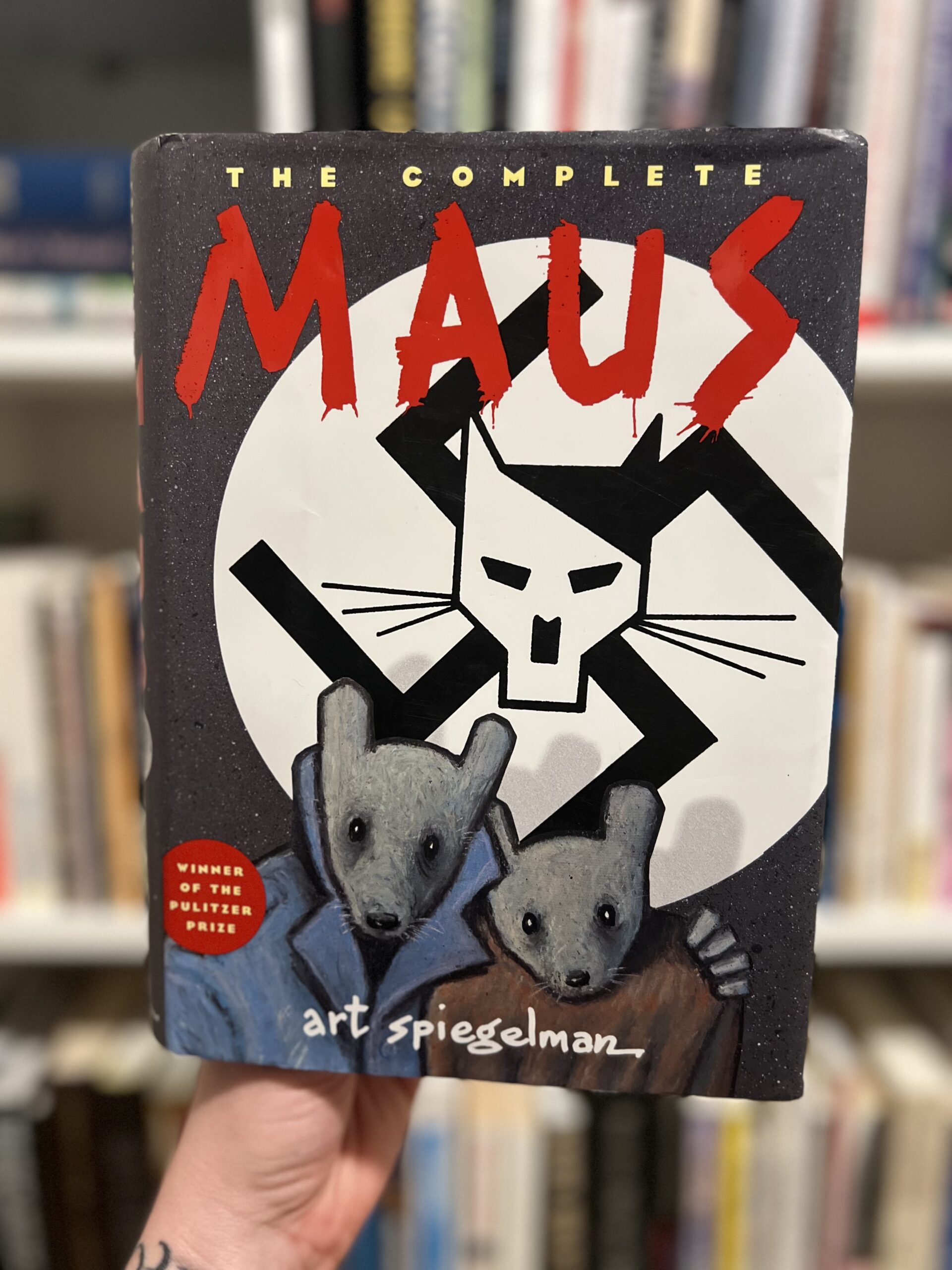
By Art Spiegelman
” No, darling! To die is easy… But you have to struggle for life! Until the last moment we must struggle together! I need you! And you’ll see that together we’ll survive.”
Summary
Cartoonist Art Spiegelman interviews his father, Vladek, about his life as a Jewish man in Poland, the events leading up to the Holocaust, his experiences in concentration camps, and finally, his liberation. The imagery is heartwrenching and haunting. And yet, the book manages to convey two of the greatest, albeit messy, love stories ever told: one between husband and wife, and the other between father and son.
Quick Info
- Year of Publication: 1996
- Number of Pages: 296
- Awards/Nominations: Pulitzer Prize, American Book Award
Why I Chose to Read The Complete Maus: A Survivor’s Tale
My background in animation makes it almost impossible for me to look away from a great graphic novel. I’m certain there are students who cringe when assigned traditional novel reading. My hope is to prepare myself to recommend graphic novels that transcend all possible expectations, delivering a phenomenal story and then some. Maus documents one of the most horrific atrocities in human history. This is an important text, and it’s hard to ignore the first graphic novel to win a Pulitzer Prize!
Teaching Considerations
Audience: Booksellers list this as “ages 1 year and up.” I agree that it’s never too early to share this story. There’s certainly violence, but it’s rendered with class, the animal caricatures bring levity, and, while it’s challenging to teach hard truths, it’s also imperative.
Key Themes: Intergenerational trauma, survival, memory, storytelling, dehumanization, and identity.
Instructional Ideas:
CHARACTER
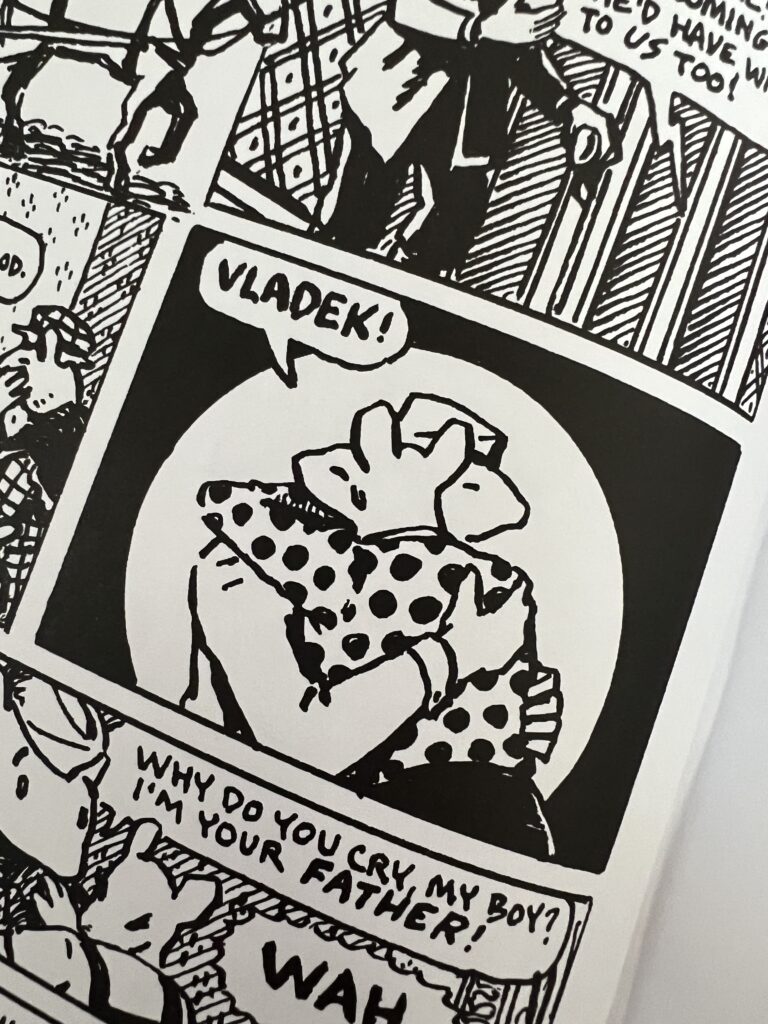
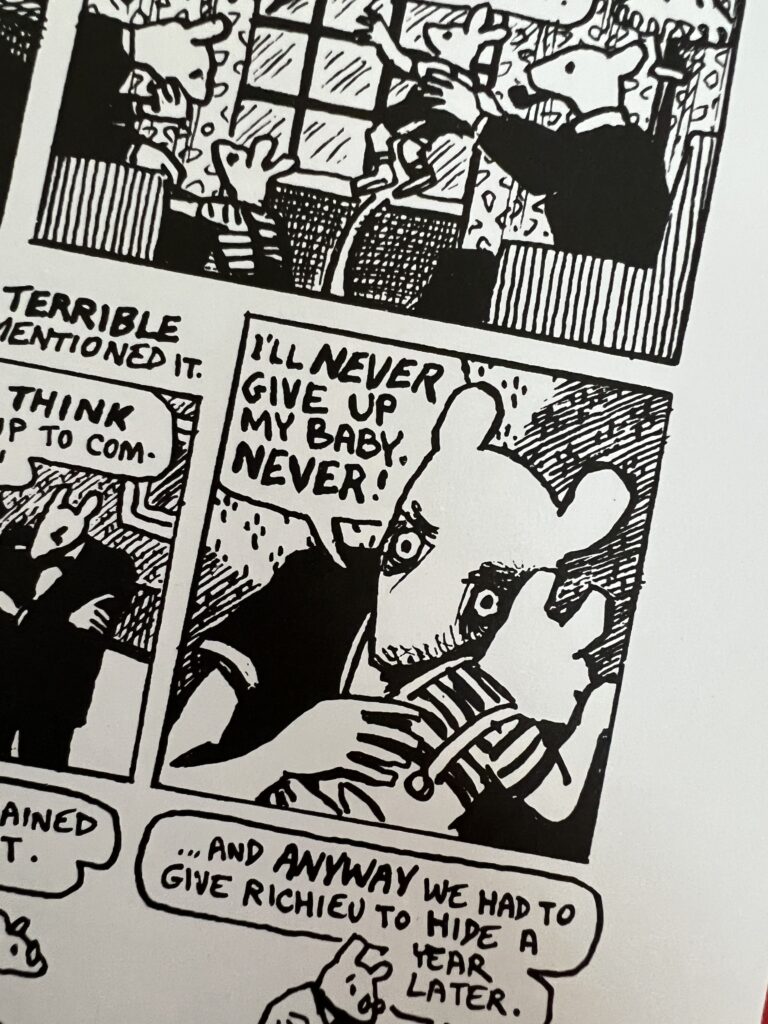
The author brings his father’s voice to life through dialect, helping readers connect with his culture. The father-son relationship is depicted with sharp realism, and there’s no sugar-coating his mother’s suicide. Remarkably, the author brings himself to life honestly as well. There’s something about the transparency of these flawed characters that makes us root for them. As much as this book is a historical time capsule of atrocities, it’s the characters who force us to keep hope alive, who make us clench up, gasp, or cry in response to their documented pain. While Art Spiegelman’s brother, Richiev, didn’t survive, he looms large. One of my favorite artistic choices in the book is how Adolf Hitler is never portrayed. He doesn’t deserve the artwork.
STRUCTURE
This edition of the book includes Maus Part I and Maus Part II, which are distinct works that were published at different times. The former documents Vladek’s life before and during the Holocaust, but ends with his arrival at Auschwitz. The latter burrows deep into Vladek’s time in Auschwitz and culminates with his liberation.
Art and Vladek narrate the story together, and we see both of their present lives, up to and beyond Vladek’s death in 1982.
ILLUSTRATIONS
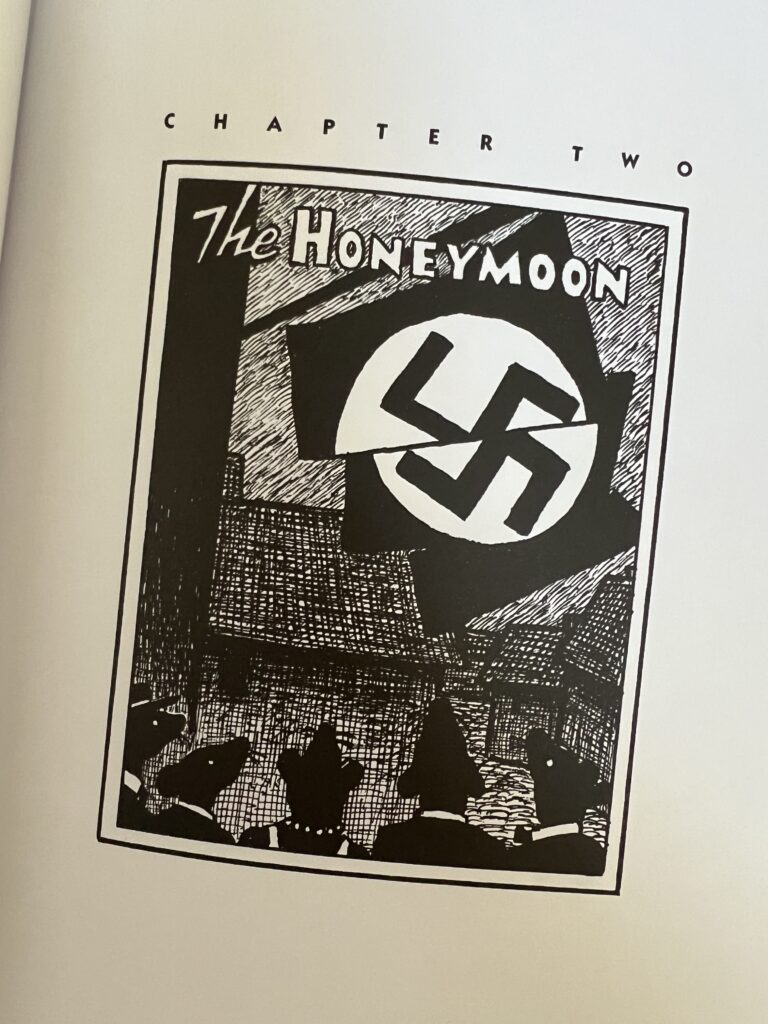
I’ll let a few of these speak for themselves:
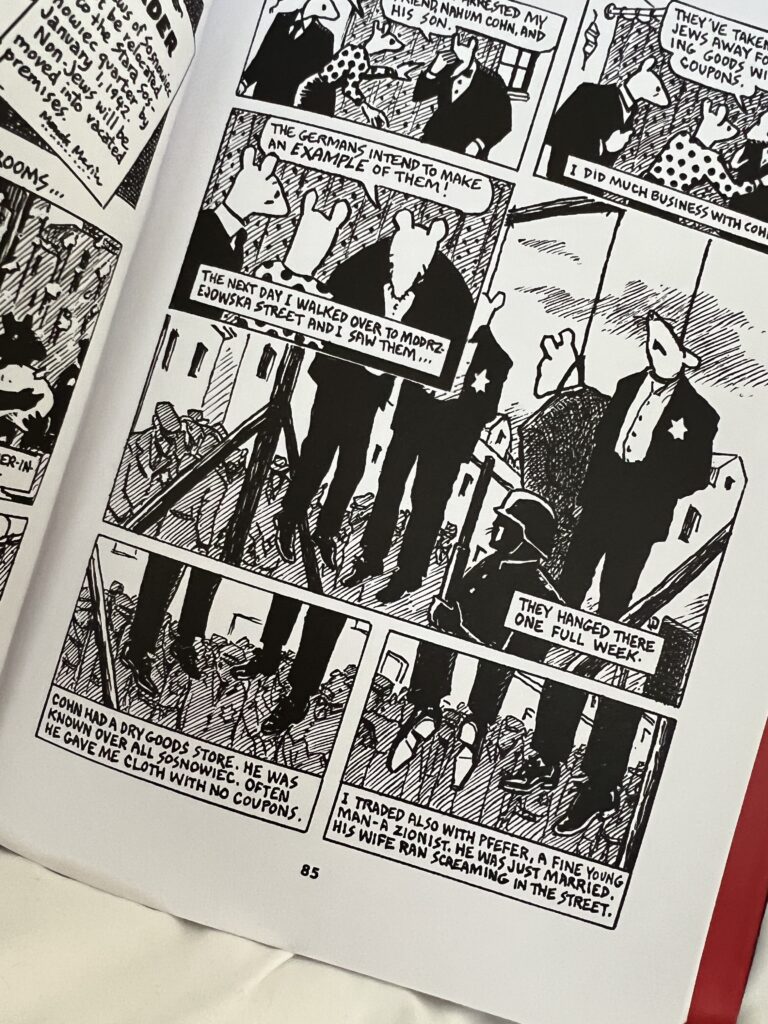
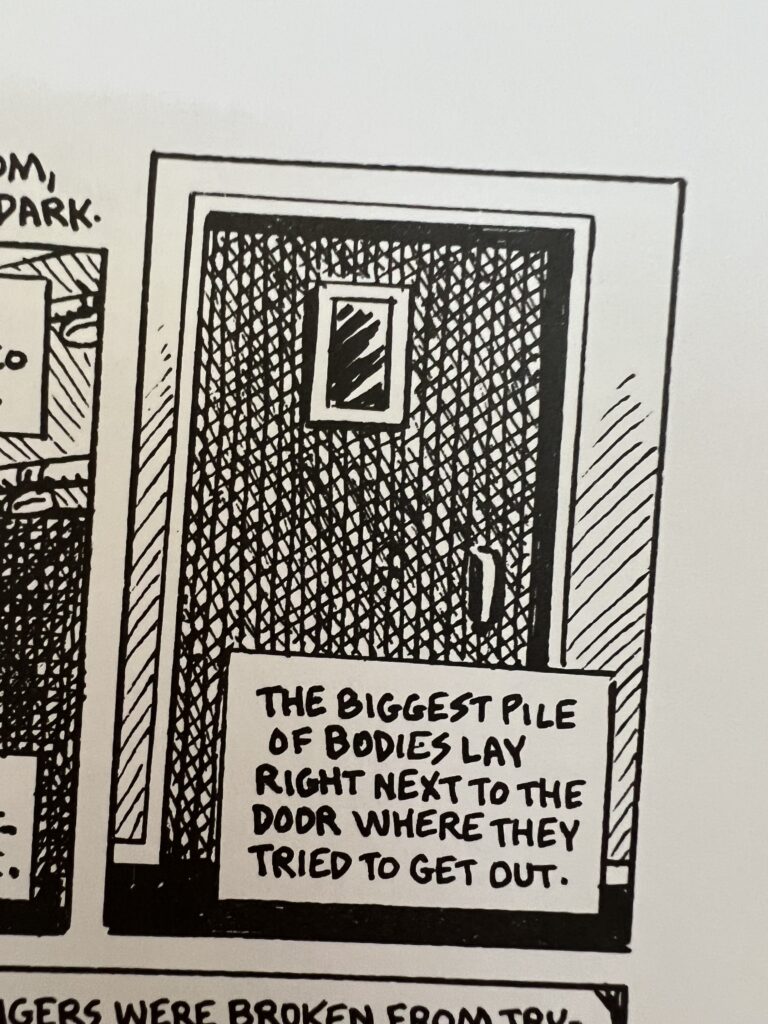
THE ENDING
What really fascinates me about this particular edition is the juxtaposition of endings between Part I and Part II. Tonally, they’re night and day.
I believe part of what makes this a masterpiece is its ultimate triumph of love over hate. Again, this book is as much a love story as it is a horror story.
Key Excerpts
“‘The Jews are undoubtedly a race, but they are not human.’ – Adolf Hitler ” – page 10
This is the only airtime Hitler gets in this book about dehumanization.
“Don’t worry so much, Vladek. You’ll see… The war will be over like lightning!
Ja! Like Lightning!
Ach!” – page 78
Why was it important for the author to include this false assumption in the book?
“So the Germans swinged them by the legs against a wall…
And they never anymore screamed.“ – page 110
How do these illustrations make you feel? You’ll notice they’re not as graphic as they could be. Why do you believe the illustrator made that choice?
“In some ways he’s just like the racist caricature of the miserly old Jew.” – page 133
How does this book treat stereotypes? Are there other moments where the author navigates stereotypes?
“Many younger Germans have had it up to HERE with Holocaust stories. These things happened before they were even born. Why should THEY feel guilty?” – page 202
What parallels do you find between the events in this book and modern life?
“Sigh. I’m not talking about YOUR book now, but look at how many books have already been written about the Holocaust. What’s the point? People haven’t changed… Maybe they need a newer, bigger Holocaust.” – page 205
How does the author’s personal storyline strengthen this story? What does it add?
My Thoughts and Reflections
★★★★★
This is an exceptional work of art. The illustrations took my mind to places darker than my imagination ever could have. Brilliantly, by using Adolf Hitler’s tricks against him and dehumanizing all the characters in this book (Jewish mice, German cats, Pig Poles, American dogs, etc.), the terrible violence integral to the telling of this story is more palatable. I adore how this is a love story at heart, between Vladek and his wife, Anja, whose relationship helped save them from the horrors of the Holocaust. It’s also a story about loving humanity, flaws and all, from abrasive Vladek, to his second wife Maya who could never live up to the standard set by Anja, to the Black man hitching a ride, perhaps oblivious to Vladek’s hypocritical stereotypes (fortunately delivered in Polish, not English), to the writer, who feels conflicted about his relationship with his mother, his father, and a cruel and sometimes nonsensical world. I honestly feel conflicted about how much I enjoyed this brilliant, 100% Pulitzer Prize-worthy book.
Topics/Ideas/Books/Authors I’m Curious About As a Result of Reading The Complete Maus: A Survivor’s Tale
I’d like to reread Eichmann in Jerusalem: A Report on the Banality of Evil. That text felt so powerful when I first read it. I’d like to see if it holds up. I’m also curious to read Persepolis, and to see what (if any) influence Maus had on it. How is it different? Similar? Are the views conflicting, harmonious, separate entirely? Was Marjane Satrapi inspired by Art Spiegelman?



Leave a Reply