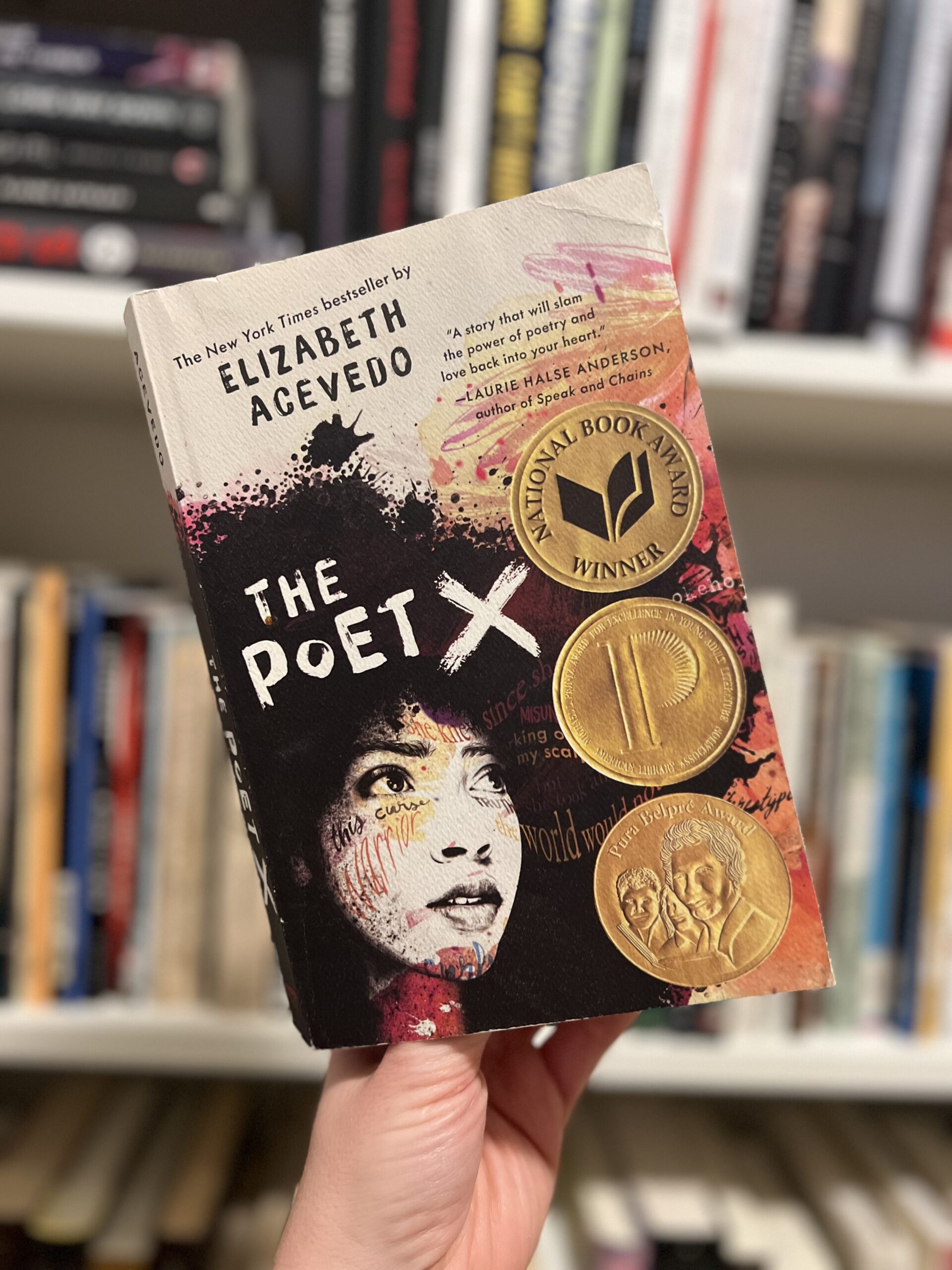
By Elizabeth Acevedo
"'My name is hard to say,
and my hands are hard, too.
I raise them here
to build the church of myself.
this X was always an omen.'
'Santa María, Madre de Dios,
ruega por nostros, pecadores,
ahora y en la hora de nuestra muerte.
Amén.'"
Summary
This is the coming-of-age story of Xiomara Batista a first-generation New Yorker, attending high school in Harlem and sharing a room with her twin brother, Xavier, in their Dominican parents’ home. Their father is a reformed cuero. Their mother would rather be married to Jesus. Because of her upbringing, Xiomara faces challenges other students might not. She’s not supposed to have a boyfriend until after college. Her mother believes going to church is the only acceptable extracurricular activity. She feels it’s her duty to physically protect her gay brother from harm. Xiomara also has supports other students might not, like her loving, caring brother, her well-behaved Catholic best friend, who accepts her for who she is, her kind and patient boyfriend, Aman, and the only teacher who ever pronounced her name right on the first day of school, Ms. Galiano. While she wrestles with religion and her strict mother, Xiomara finds her voice in poetry.
Quick Info
- Year of Publication: 2020
- Number of Pages: 384
- Awards/Nominations: Winner of the National Book Award for Young People’s Literature, the Michael L. Printz Award, and the Pura Belpré Award
Why I Chose to Read The Poet X
I could not find a novel in verse that came more highly recommended.
Teaching Considerations
Audience: Booksellers list this as “ages 12+.” For any interested early readers, I’d shift this to 10+. It’s so graceful in its delivery, with a narrator that asks hard questions and also sets a great example, over and over, of not caving to peer pressures.
Key Themes: faith, religion, family, bilingualism, twins, friendship, creative writing, first love, LGBTQ+
Instructional Ideas:
CHARACTER
The Poet X is told from the perspective of its narrator, Xiomara, so we see biased glimpses of every other character. Still, Xiomara is wise and respectful, and so by the book’s end, all of the characters are fleshed out and humanized.
Through character, the author shows a variety of Catholics, allowing Xiomara to ask hard questions and be critical of religion without attacking it outright or denigrating practitioners.
STRUCTURE
The book follows Xiomara chronologically through her sophomore year of high school, using poetry, and adds layers through Xiomara’s rough and final drafts of five homework assignments from Ms. Galiano.
STORY
While the mother-daughter emotional rift is front and center, Elizabeth Acevedo does an incredible job telling the emotional journey of this whole family, who experience Xiomara’s coming-of-age together in one home.
Key Excerpts
“‘Pero, tú no eres fácil.’
You sure ain’t an easy one.” – page 10
What does the inclusion of Spanish do for this story? There are many times when it isn’t translated into English. Why do you think the author made those choices?
“‘…My pops never wanted to put me in classes. Said it was too soft.’
And now his smile is a little sad.
And I think about all the things we could be
if we were never told our bodies were not built for them.” – page 188
How does this book break down gender norms? There are multiple examples. How many can you find?
“‘Altagracia, please be calm.
Remember anger is as much a sin
as any Xiomara may have committed…’” – page 229
Who is Father Sean? What role does he play in Xiomara’s life, and how does his presence serve the narrative?
“She starts reading,
her hands fluttering in the air.
I put my apple down to focus,
because this feels like an important moment.
When she’s done, she doesn’t look at me.
And Idabelle isn’t the type not to look at someone.
I don’t tell her it’s good, even though it is.
I don’t tell her it’s beautiful, although it’s that, too.
‘That gave me chills,’ I say.
‘I felt it here,’ I say.
‘You should finish it,’ I say.
And when she smiles at me
I smile back.” – pages 284-285
How is friendship depicted in this book? What does friendship look like to you?
Book Talk Excerpts
“The Ugly
I’m breathing hard by the time I get home.
I ran from the train and my face is flushed.
I glance at the kitchen table before hurrying
to my room—my notebook isn’t there.
Mami is sitting on the edge of my bed
with my journals cradled between her hands.
When she looks at me,
I feel blood rush from my cheeks.” – page 300
What’s the most important thing you’ve ever created? What’s something in your life that means more to you than almost anything? What would you do to protect it, and why?
My Thoughts and Reflections
★★★★★
I typically avoid poetry, opting for storytelling formats that provide deeper explorations of character and story. This book obliterated my assumptions about what poetry can and cannot achieve. The story was novel-rich, and characters were full-bodied. I can see why any teacher might cling to it, as Xiomara clings to her writing and pays respect to Ms. Galiano. I also have a personal connection to this, as I lived and worked in the neighborhood where the Nuyorican Poets Cafe is located, and I had a similar anxiety-inducing, voice-finding moment at the Bowery Poetry Club, a few avenues away. This book is so beautiful, and I intend to show it to my daughters someday soon…
Topics/Ideas/Books/Authors I’m Curious About As A Result of Reading The Poet X
My first thought is that I’d love to read Xavier Batista’s coming-of-age story, but that doesn’t exist. I see that The Poet X film has been in development with Netflix since 2020. I’m curious to know whether the screenwriter contemplated creating a two-hander (dual-protagonist) screenplay. Maybe it would be best to have two separate films…? I’d watch any variation of these and eat up the screenplays!
I’m curious to read more work by Nuyorican poets.
I’d also enjoy reading more YA books that use translanguaging and/or have multilingual elements. Cemetery Boys, Never Look Back, Lobizona, and Woven in Moonlight appear to be great starting points. It doesn’t look like there are tons of options here, so perhaps another route would be to simply purchase two versions of a book I love, one in English and another translated into a different language.
Leave a Reply