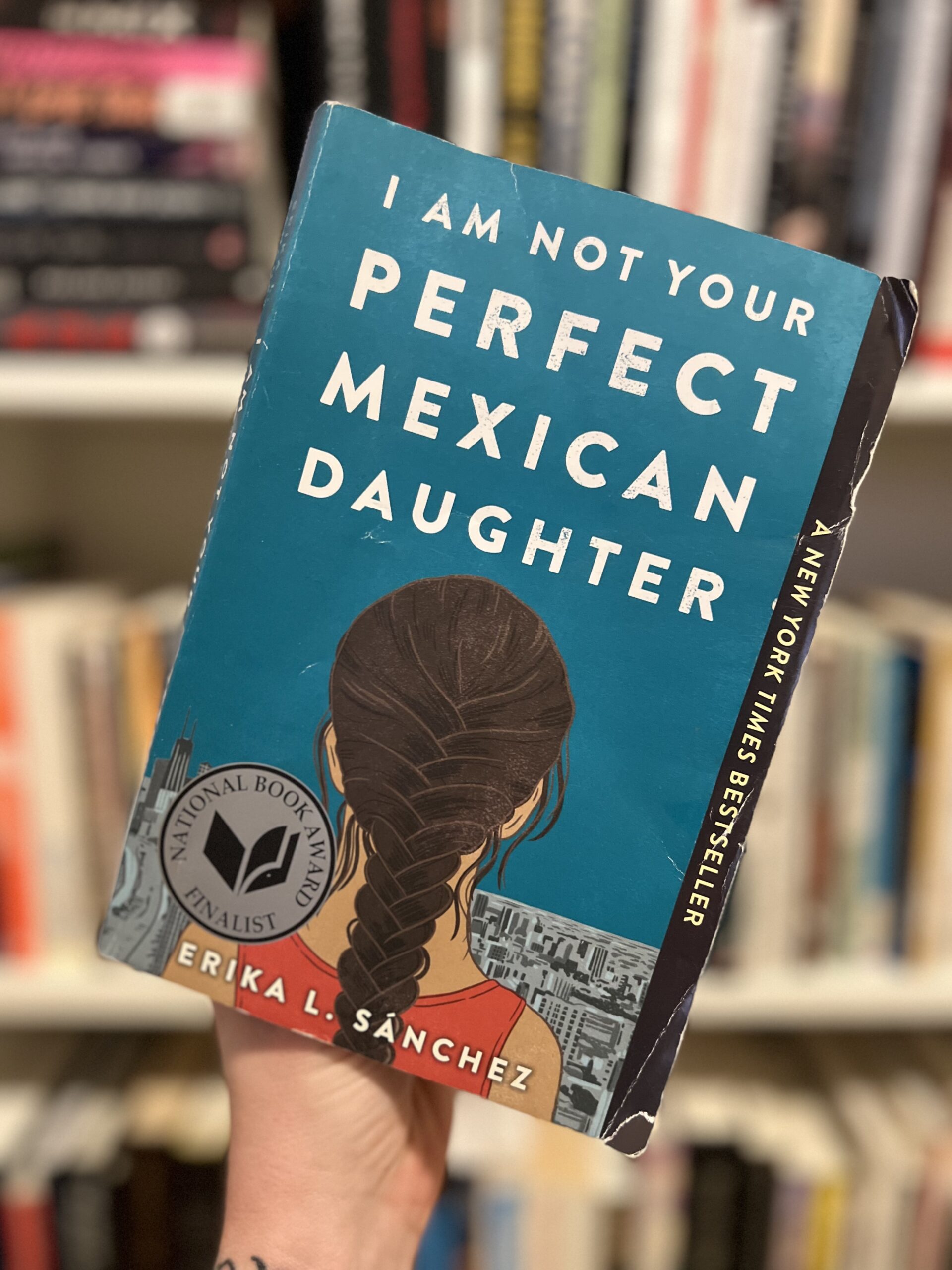
By Erika L. Sánchez
“She has compared me to my sister every single day of my life, so why should I expect that to change now that she’s dead?”
Summary
In I Am Not Your Perfect Mexican Daughter Julia Reyes navigates grief, depression, and identity during her junior and senior years of high school after her seemingly perfect sister, Olga, gets hit by a semi. The book is also part mystery, as Julia uncovers secrets about Olga’s hidden life, deepening her understanding of her sister, her Mexican immigrant parents, and herself. A self-proclaimed outsider who prefers books to people, Julia slowly learns to connect with friends and family, question expectations, and imagine a future beyond her pain.
Quick Info
- Year of Publication: 2017
- Number of Pages: 352
- Awards/Nominations: National Book Award Finalist, Thomas Rivera YA Award
Why I Chose to Read I Am Not Your Perfect Mexican Daughter
Living in Colorado and having attended Denver Public Schools, where over 50% of the student body is Latino, I realize how crucial it is for me to invest in stories like Julia’s. My great-nieces’ dad was a Dreamer and has since become a U.S. citizen. My best friend growing up was Mexican-Italian-American. She was “not your perfect Mexican daughter” by any stretch. I read this for students like her, who struggled with identity at home and at school.
Teaching Considerations
Audience: Booksellers list this as “grades 9-12.” I’d adjust this to “grades 7+. There are some really heavy, traumatic moments and lots of underage drinking and drug use. The narrator navigates through it all, growing and learning, which is stellar, and might influence some middle schoolers for good. I’d also do away with the maximum age. This is a great book for adults, too.
Key Themes: grief, loss, mental health, cultural identity, immigration, family expectations, friendship, acceptance, and the myth of perfection.
Grouping Recommendation: This would be a great text for a book club assignment. I think it’s perfect for small-group learning, where students could bond over the harsh reality, humor, and strength of the protagonist.
Instructional Ideas:
CHARACTER
Aside from the beautiful, imperfect family depicted in the book, Sánchez offers two friends, Lorena (as confident as Julia is not) and Juanga (undeniably flamboyant with a home life more chaotic and traumatizing than Julia’s), and two love interests, Connor (a white, affluent, U.S. citizen), and Esteban (a Mexican who wants to live in the USA). There’s also a variety of teachers and a sensitive, empathetic therapist, Dr. Cooke. All of these characters are architected to create tension and to help us learn more about Julia.
STORY
At its core, this is a story of a young woman growing to empathize with and appreciate her parents. All have experienced trauma. All have coped in their own ways. While shocking moments and blunt dialogue and narration are deployed throughout, the emotional story plays out subtly. It’s truly moving in its quietness.
VOICE
Of all the YA texts I’ve read, this one strikes me as having the most authentic teenage narrator. Sánchez’s brilliance really shines here. Her use of subtext throughout, exploring what is said and unsaid between parents and teens, is phenomenal and would no doubt help young readers engage.
STRUCTURE
I Am Not Your Perfect Mexican Daughter unfolds chronologically with numbered chapters. It skips through time, but isn’t jarring, except at the end of the second act, during Julia’s lowest moment. The story is wonderfully, intentionally engineered.
Key Excerpts
“José Luis is always lounging around the house in an undershirt, listening to norteñas and polishing his pointy crocodile-skin boots. Instead of leaving us alone like any normal dad, he’s always asking dumb questions about music, school, and boys. I wish he’d just shut up and leave us alone.” – page 68
This book depicts and mentions too many scenes of misogyny and harassment/ abuse to count. Sadly, this is such an accurate illustration of what it’s like to be a teenage girl. Which scenes did you find jarring? Why? And how do you think these experiences have shaped Julia’s attitude in the book? How do you know?
“A roach crawls under my bed, but I don’t bother killing it.” – page 335
Why do you think the author scatters roaches throughout this book? What do they symbolize, and how does that connect with Julia’s story and the setting?
Book Talk Excerpt:
“As I’m daydreaming about more images for my poem, Mr. Simmons calls on me, of course. He probably noticed my hatred for him pulsing around me.
‘Julia, what is the answer to problem four?’ He takes his glasses off and squints at me. He says my name the wrong way (Jewlia), even though I already told him how to pronounce it. Amá has never let me say it the English way. She says she’s the one who named me and that people can’t go around changing it for their own convenience. We agree on that, at least. It’s not like it’s hard to pronounce.
‘I’m sorry. I don’t know,’ I tell Mr. Simmons.
‘Were you paying attention?’
‘No, I wasn’t. Sorry.’
‘And why not?’
My face feels hot. Everyone is watching me, waiting for my humiliation like vultures.” – page 36
“When I told Mr. Ingman about the responsibility I felt to Olga, to my family, he told me I had to write about it. In fact, he pretty much forced me to do it then and there. That day I sat in his classroom for nearly two hours, crying over my notebook, smearing the ink on the pages. Mr. Ingman never said a word the whole time. He just touched my shoulder and then sat at his desk until I finished.” – page 340
This book depicts a handful of teachers, and I think the comparison between Mr. Simmons and Mr. Ingman, both white, male teachers, says a lot. I specify race here, as nearly 80% of public school teachers in the USA are white, while only around 58% of the population in the USA is white. What do we look for and need from adults when we’re about to escape high school and jump off the precipice into adulthood? What qualities make a teacher supportive or harmful? Can you think of a teacher who changed your life for the better? What did they do?
My Thoughts and Reflections
★★★★★
This book helped me better understand some of the struggles that Latino immigrants and their children face in the USA. It also explores mental health in the most powerful way possible. I wish I had had a book like this to read when I was in middle and high school. It might have inspired me to make smarter decisions. Oddly, with how weighty all of that sounds, it’s also a humorous, fun ride, with a sharp, compelling protagonist. Highly, highly recommended.
Topics/Ideas/Books/Authors I’m Curious About As A Result of Reading I Am Not Your Perfect Mexican Daughter
Interestingly, Cemetery Boys, Clap When You Land, Furia, and Sanctuary were all published in 2020. They look like fantastic reads. I’d also like to read House on Mango Street. I believe this was part of my high school language arts curriculum. If memory serves, we read just a short excerpt, which is a shame, because an excerpt rarely does a full book justice.
Also, Just Like Us: The True Story of Four Mexican Girls Coming of Age in America is a great non-fiction text set in Colorado. It’s generally recommended for 18+, but I’d like to reread it to see if there are excerpts I could pull out to use as teaching supplements with I Am Not Your Perfect Mexican Daughter.

Leave a Reply