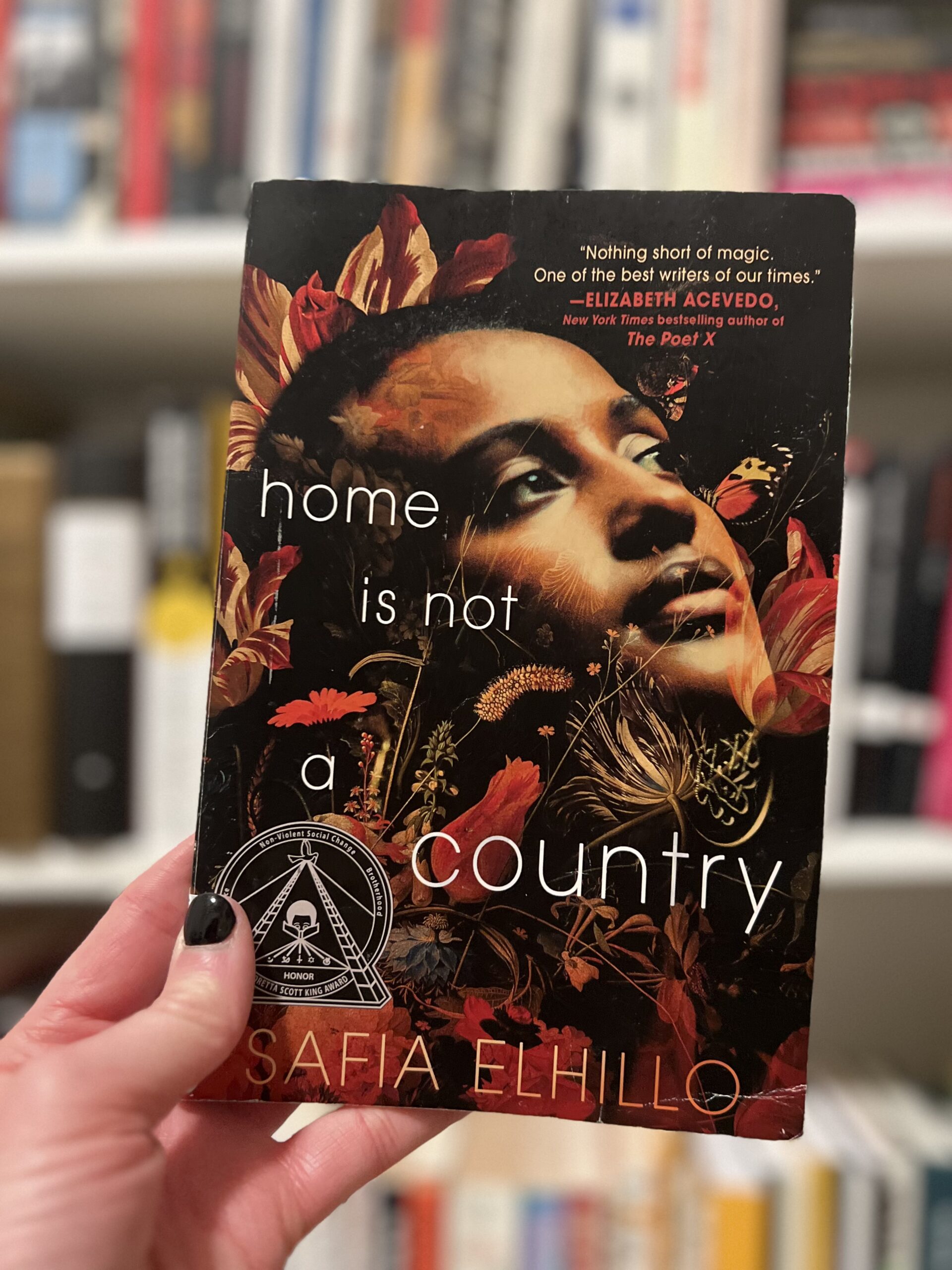
By Safia Elhillo
“…i’ve mixed up the words & the word
for home i’d been using this whole time
was homeland“
Summary
This is the coming-of-age story of Nima, the U.S.-born daughter of her immigrant mother, who grapples with the concept of home. Is the USA home, even if Nima’s peers and neighbors don’t treat her equally? Who would she be if she were able to grow up in her “home country” with other Muslims who looked like her and spoke Arabic? Throughout the book, she imagines Yasmeen, her alternate self. This is also a story of grief, as Nima’s father died before she was born, leaving her and her mother to navigate their new lives together. They are not alone, however, as Nima’s best friend Haitham and his mother and grandmother (also immigrants) live in the same apartment complex. Ultimately, after enduring emotional and physical xenophobia and gut-punching rifts with those closest to her, Nima forms a deep cultural identity she’s proud of and understands that belonging is a place she must create for herself.
Quick Info
- Year of Publication: 2021
- Number of Pages: 224
- Awards/Nominations: Coretta Scott King Book Award Honor, Arab American Book Award, National Book Award, Children’s Africana Book Award, YALSA Best Books for Young Adults, CBC Notable Social Studies Trade Books for Young Readers, Rhode Island Teen Book Award
Why I Chose to Read Home Is Not a Country
I went to schools that championed the United States as a mecca of immigrants, and then I traveled, lived, and worked with people from all over the world for two decades. The title of this book rang true to me, even before I opened it.
Teaching Considerations
Audience: Booksellers list this as “ages 12 to 17.” I think you could broaden this in either direction. Adults could get as much out of this as young people. Also, with a bit of support from a trusted adult to navigate a few instances of violence, this book might land well with some younger readers.
Key Themes: identity, belonging, grief, duality, community, chosen family, language, nationality vs. ethnicity.
Grouping Recommendation: This would be a great choice for book club readings and potentially for small-group readings that relate to a larger unit. For example, in an American Lit class, this could be one of many books with differing points of view on what it means to be “an American.”
Instructional Ideas:
CHARACTER
This book illustrates the power of chosen family through curious and resilient teens (Nima and Haitham), strong single mothers (Aisha/Mama and Khaltu Hala), absent fathers, and the wisdom of elders (Mama Fatheya.)
STORY
Home Is Not a Country is a story of self-discovery, and Safia Elhillo brilliantly narrates the arc of Nima and Yasmeen, with a beginning, fantastical reckoning, and release. The book also details the obstacles in first and second-generation immigrant parent-child relationships while also celebrating universal mother-daughter love. Finally, the book beautifully captures the wealth of friendship.
Every character in the book’s chosen family has an emotional arc, and the author also does a brilliant job of depicting the teens’ fathers’ backstories with care.
LANGUAGE
The author’s inclusion of Arabic text and song without translation elevates the richness of Nima’s identity-seeking narrative.
STRUCTURE
This novel in verse is divided into three parts with a prologue: “New Country” (prologue), “The Other Side,” “Old Country,” and “Home Is Not a Country.” This typical three act structure does not lack creativity, as the protagonist’s lowest point in act two leads her to a fantastical, historic climax in her “old country” that’s truly riveting.
Key Excerpts
“nima well really it’s نعمة ni’ma
mispronounced at school to sound like
the middle of the word animal or stretched
into a whining neema no letter in english
for the snarling sound that centers my name
its little growl ﻉ ” – page 15
There’s power in a name. Do you agree? What’s your name, and where did it come from? Would you ever rename yourself? What and why?
“i’m dressed as your terrorist mom & everyone
howls with laughter another wraps a sweater
around his head like a turban & i’m
your terrorist dad” – page 49
This book depicts several instances of xenophobia, which forces Nima to question her identity and self-worth. Have you ever felt othered? Have you ever made your peers feel othered? What did you learn from your experience?
“the younger woman puts one hand on my shoulder
nails stained red-brown with henna
smooths my hair with her other palm
& asks do you speak arabic?
still flustered by the spreading chaos i’ve made
with my half language i shake my head no
she clicks her tongue in disapproval & turns to speak
to the older woman look at her hair the dirty clothes
i don’t think this girl belongs to anyone” – page 107
On top of this exchange, Safia Elhillo regularly pulls readers into Nima’s Arabic class, where she feels othered by students who have assimilated into American culture. One student even makes fun of her mother’s headscarf. How does showing a spectrum of Arabic language speakers serve this story?
Book Talk Excerpt
“Street Fair
i wander through the maze of color & smell
a parade running like a vein through the middle
& all around i see booths draped in what looks
like every flag i think for a second to look
for mine & of course it is not there mine
not a culture exciting enough for a booth for a fair
only ever mentioned in a list of warnings on the news” – page 91
Why do you think Safia Elhillo never mentions her home country of Sudan by name in this book? Where are you from? What flag do you claim, if any? Why? How do you define “home”? Why?
My Thoughts and Reflections
★★★★★
I read this first and foremost as a daughter and a mother with daughters, and I loved every minute. It’s also a timely read, as war and climate change have displaced record numbers of people, and the United States government is currently committing the mass imprisonment, deportation, and murder of immigrants. I’m currently learning Arabic, so I switched between the printed text and the audiobook to get a stronger sense of Nima’s story. While I typically shy away from fantasy, Safai Elhillo held readers by the hand and, in my opinion, led her protagonist to a fully earned, stunning climax of magical realism. Highly recommended for anyone navigating identity, immigration, loss, single-parent homes, culture, and bigotry.
Topics/Ideas/Books/Authors I’m Curious About As A Result of Reading Home Is Not a Country
This book would pair well with The Poet X for book groups studying novels in verse. Since both texts center on female protagonists, I’d like to read a wider variety of books in this format to better support student choice. Rebound, by Kwame Alexander, All the Broken Pieces, by Ann E. Burg, A Million Quiet Revolutions, by Robin Gow, and Louder Than Hunger, by John Shu, all look like great reads!
Leave a Reply