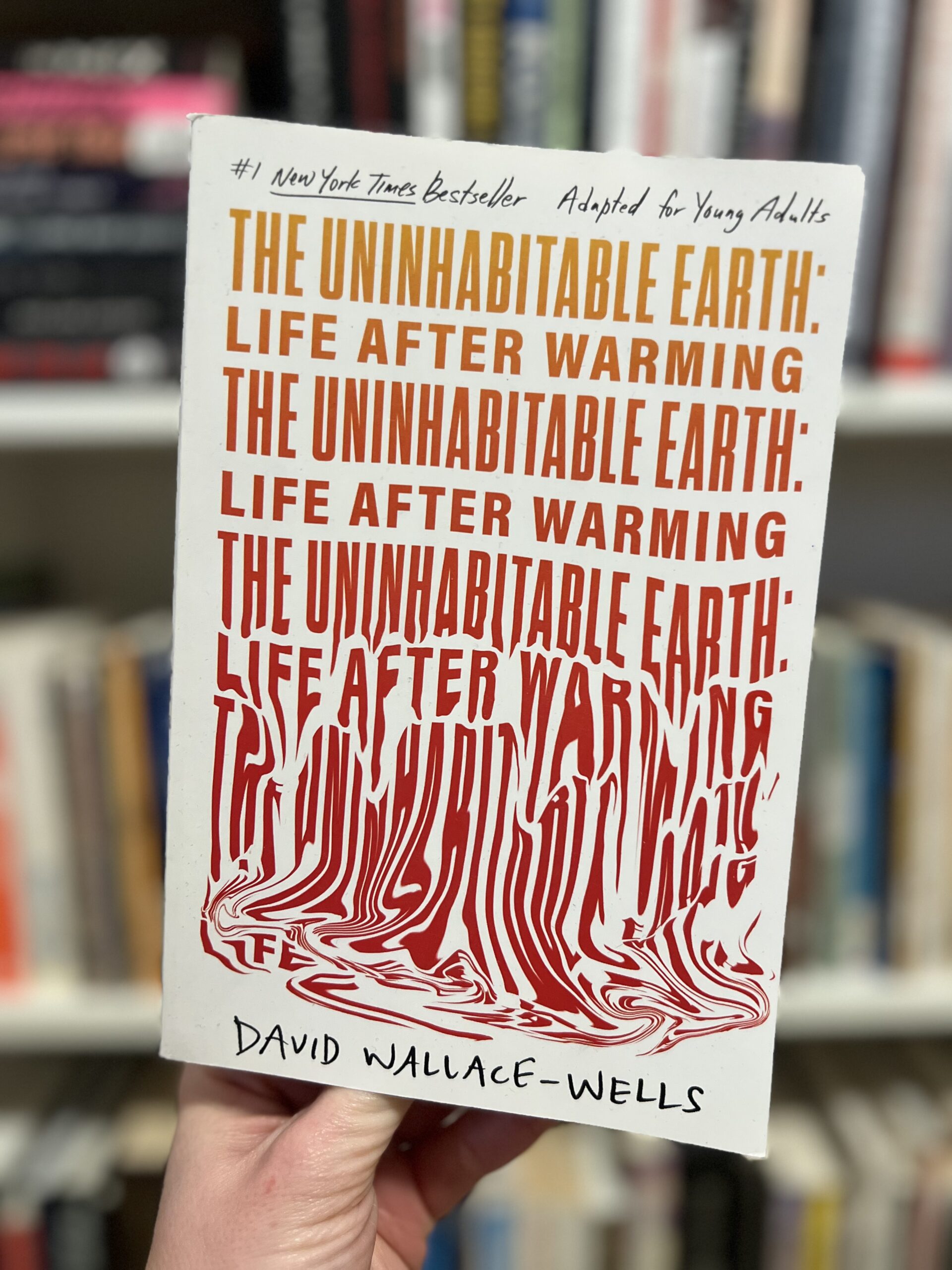
By David Wallace-Wells
“It is okay, finally, to freak out.”
Summary
This book is adapted from the 2019 bestseller for young adults. It begins with a quick history of Earth’s mass extinctions, defines the rise in atmospheric carbon dioxide as the cause of global warming, and orients readers by using Celsius as the measurement scale and estimating that, if we don’t change course, we could hit 3 degrees of warming by 2100. (5 degrees of warming led to mass extinction 250 million years ago.) David Wallace-Wells then explores eleven “elements of chaos” in extreme detail (Heat Death, Unbreathable Air, Plagues of Warming, etc.) From there, he details how humans are grappling with climate change and defends his alarmist stance. The book concludes with a call to action aimed at its YA audience.
Quick Info
- Year of Publication: 2023
- Number of Pages: 176
- Awards/Nominations: The book’s 2019 predecessor was a New York Times #1 Bestseller
Why I Chose to Read The Uninhabitable Earth
Several years ago, a company I worked for pushed all employees to deepen our environmental awareness during Earth Month. We participated in action events and won prizes for completing readings, short courses, quizzes, and watching documentaries. Plastic China horrified me! It also inspired me to continue researching and supporting environmental causes and preservation efforts. I’m no green pro, but I do believe we have TONS of work to do, and I’d love to help inspire students to care and take action.
Teaching Considerations
Audience: Booksellers list this as “ages 12+.” I agree with this assessment. If I read this book to my young girls, they’d likely have nightmares or anxiety. (That’s not to say that a different, less “the world is on fire!” text on climate change wouldn’t be great for them.)
Key Themes: climate change, climate justice, interconnected systems, global inequality, psychological/cultural/political denial, technology, and moral urgency.
Grouping Recommendation: This would be a great choice for book club readings in nonfiction vs. fiction units. It might also be eye-opening enough to make for a very lively full class read.
Instructional Ideas:
VOICE
On page 5, David Wallace-Wells explains, “I am not an environmentalist and don’t even think of myself as a nature person.” Maybe not, but he is a journalist, obsessed with climate change. (Perhaps because he lives and works in NYC, and according to this book, big cities will get hit hardest by “Heat Death.”) The Uninhabitable Earth reads like a somewhat terrifying lecture from an elder, and I like that about it. At this point, scientists could scream from rooftops, and it feels like the public could generally care less. While reading, I thought about how slow we are to “un-blind ourselves to human exceptionalism” (p. 123). It reminds me of how many times in my life my parents gave me advice that I disregarded in favor of learning lessons the hardest, most painful ways possible. For future generations who will suffer due to our inability to overcome this Stay Puft Marshmallow contest, I hope humans collectively do better!
STRUCTURE
The way this book is organized lends itself well to a combination of full-class and small-group reading. The intro and concluding sections are short and sweet, and might make for great in-class reading for all students. I’d suggest having groups of 2 or 3 pick a chapter from the “elements of chaos” section to read and give a mixed-media presentation on what they learn.
Key Excerpts
“And the effect would be fast: after a few hours, a human body would be cooked to death from both the inside and out” – page 17
David Wallace-Wells does a great job of palpably describing the physical effects of climate change. You can see, smell, and feel what he writes. Does this scare and paralyze you? Does it rouse anger in you? Why might this author want readers to have visceral reactions?
Think of something you really want your family to give you (e.g., Nikes, a video game, concert tickets, ice cream, more time together, less time babysitting your sibling, etc.) Using at least one sense, write about your suffering because you can’t have that thing. Do you think your argument will move your parents to action?
“Thirty-two weeks after Hurricane Andrew hit Florida in 1992, killing forty, more than half of children surveyed had moderate PTSD and more than a third had a severe form; in the high-impact areas, 70 percent of children scored in the moderate-to-severe range fully twenty-one months after the Category 5 storm. By dismal contrast, soldiers returning from wars are estimated to suffer from PTSD at a rate between 11 and 31 percent ” – page 82
Here, the author delves into the mental health effects of climate change. Would this emotionally charged excerpt have been equally or more powerful without data? Why or why not? What’s a real-life cause that’s meaningful to you that you believe you could collect data to illustrate? What data might you collect?
“In fact, we have imagined solutions; more than that, we’ve developed them, at least in the form of green energy. We just haven’t yet discovered the political will, economic might, and cultural flexibility to install and activate them, because doing so requires something a lot bigger and more concrete than imagination—it means nothing short of a complete overhaul of the world’s energy systems, transportation, infrastructure, and industry and agriculture” – pages 104-105
When you read something like this, how does it make you feel? Inspired? Defeated? Why? If it inspires you, what do you believe the strengths of an “alarmist” book like this are? If it makes you feel defeated, how might you communicate this information differently?
Book Talk Excerpt
“As an unusually wealthy country, the United States is, for now, unusually suited to withstand such disruptions—one can almost imagine, over the course of a century, tens of millions of resettled Americans adapting to a ravaged coastline and a new geography for the country. Almost. But warming is not just a matter of sea level, and its horrors will not hit nations like the United States first. In fact, the impacts will be greatest in the world’s least developed, most impoverished, and therefore least resilient nations—almost literally a story of the world’s rich drowning the world’s poor with their waste” – page 78
As students in a U.S. classroom, I’m curious to hear your thoughts on this passage. What does it make you think, and how does it make you feel?
My Thoughts and Reflections
★★★★
I think The Uninhabitable Earth is an important book that serves its purpose. There are readers who will be most inspired to action after reading stark, horrifying excerpts about the future of life (and mass suffering and extinction) on Earth. I loved the simplicity of the intro and conclusion, and the brain-exploding exploration of climate degradation in the “Elements of Chaos” section. However, though I found the “The Climate Kaleidoscope” section insightful in places, it lacked weight as a whole. I’d bet there’s an entire The Habitable Earth book’s worth of content that could have been included, depicting more hopeful, concrete solutions historically, in the present, and in the future. Perhaps I should check out the 2019, non-YA version of the book to see if it’s more impactful? Also, the book is dated, presuming that anyone who owns a Tesla is a liberal environmentalist, and assuming (optimistically) that American politics are headed in greener directions. Unfortunately, the “Golden Age” of the Trump administration hasn’t pushed us toward progress, and I’m willing to bet our reality is even bleaker because of ongoing global inaction. Of course, that’s a bet I’d love to lose any day!
Topics/Ideas/Books/Authors I’m Curious About As A Result of Reading The Uninhabitable Earth
I’d like to read more YA books about climate change. Optimistic (but not toxically optimistic), solution-oriented texts would be my preference. How We Know What We Know About Our Changing Climate is a middle-grade book by Gary Braasch. It won the AAAS Science Book Award and the Ansel Adams Award. Apparently, it includes stunning photography and centers on children and families. I’m also interested in reading The Story of More (Young Readers Edition) by Hope Jahren, who was a recipient of three Fulbright Awards and was recognized as one of Time magazine’s 100 most influential people in the world. It features accessible science and is action-oriented. I wish I had a larger collection of titles to choose from.


Leave a Reply