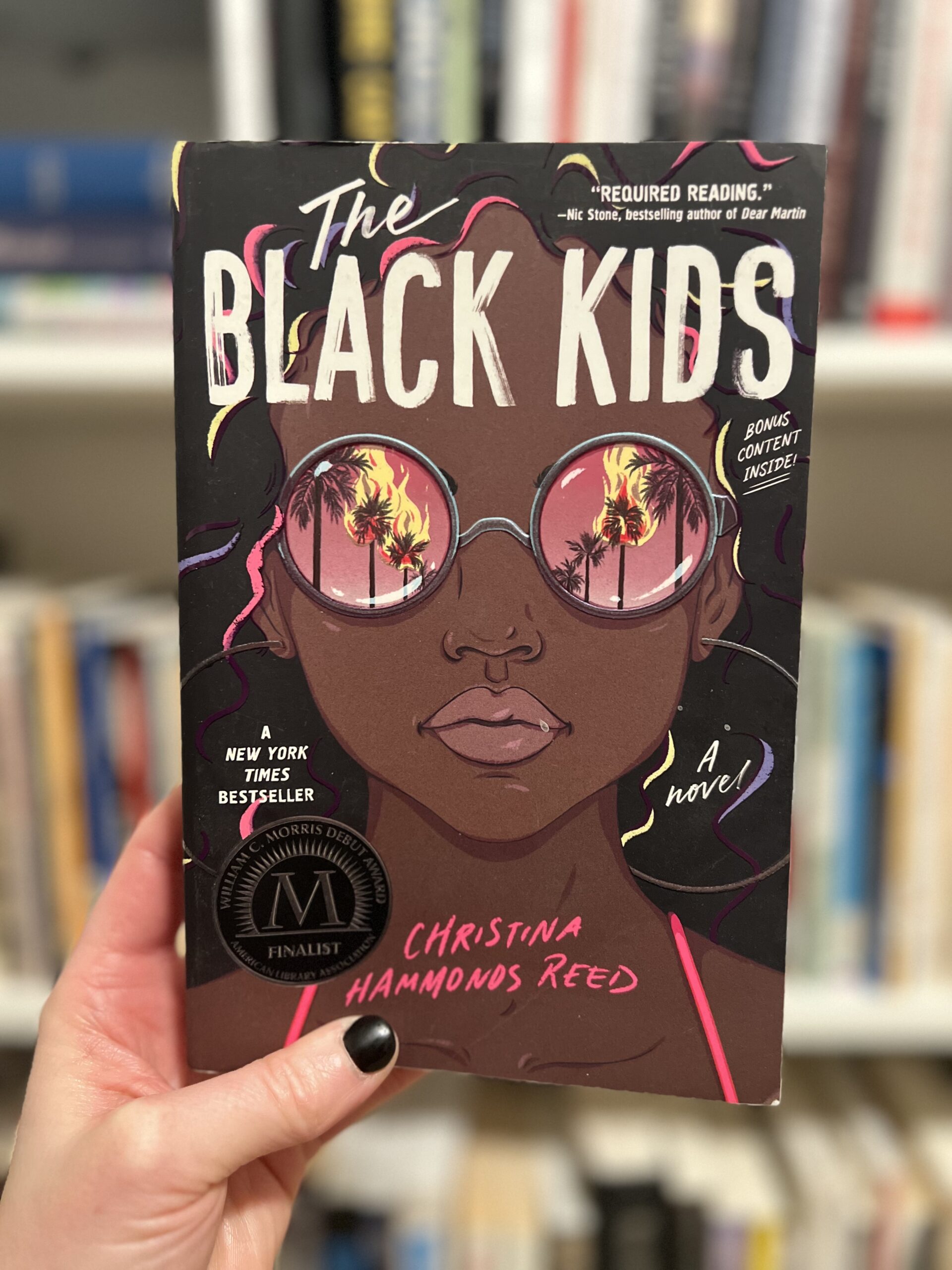
By Christina Hammonds Reed
“Sometimes there is an us, sometimes there is a them, and sometimes it’s okay to be a we.”
Summary
The Black Kids is about Ashley Bennett, a popular high school senior in Los Angeles whose world turns sideways after the 1991 videotaped beating of Rodney King and the acquittal of the officers involved, sparking the 1992 LA Riots. Ashley is Black and wealthy. Her successful parents have done everything possible to give her and her sister a safe, comfortable life, and she has spent much of her life surrounded by White friends, often giving them grace when it wasn’t deserved. But now, it’s hard not to be conscious of race, especially when Ashley’s older sister, Jo, becomes increasingly active in the fight against racial injustice. Ashley’s extended family and her grandmother’s store are also at risk as the city erupts around them. This is the coming-of-age story of a young woman navigating old friends, new friends, bad crushes, good crushes, prom, mistakes, making it right, and connecting with the Black kids at her high school, all while fires burn in the background.
Quick Info
- Year of Publication: 2020
- Number of Pages: 368
- Awards/Nominations: William C. Morris Debut Award, California Book Award Silver Medalist
Why I Chose to Read The Black Kids
I travel to LA frequently, and have grown to love so much about it. I remember seeing the Rodney King news footage on TV when I was a kid. It’s severely depressing to think about the continued police violence since that time, but I think it’s important to listen to and support Black voices, and to advocate for change. I also thought a 90s period piece would be an interesting read.
Teaching Considerations
Audience: Booksellers list this as “14+.” There is profanity, drug use, underage drinking, trespassing, and (seemingly unprotected) sex. Hammonds Reed also uses the N-word very thoughtfully and impactfully throughout the book. For these reasons, I can see why teachers might not recommend this as a full class read. However, I believe this book conveys powerful messages that would resonate with middle school students as well. I’d recommend guided reading, where an adult and young person could talk everything through.
Key Themes: subtle and overt racism, identity, family, sisters, voice, privilege and class, friendship, betrayal, and social and political awakening.
Grouping Recommendation: This would be a great small-group read in a unit on historical fiction. I can also see it being a great fit for student(s)-to-teacher journaling.
Instructional Ideas:
CHARACTER/STORY
This book is about Ashley’s identity, within her immediate family, extended family, at school, in the wider community, and in the world. I’m inspired by the author, who created a protagonist with a limited perspective who makes messes like a true dazed and confused teenager, but who also has integrity and is infinitely rootable.
Jo, Ashley’s sister, provides the main relationship arc. She’s an activist by choice who believes, with everything in her, that she has no choice. I adore her for it.
Ashley’s extended family offers readers a window into generational atrocities, racism, and responses to them.
Ashley’s White friend group provides views of judgment, acceptance, and conscious and unconscious racism.
Ashley’s Black friend group is as intra-diverse as they come, and non-judgemental when she needs it most.
There are tons of characters in this book. Some of the most impactful ancillary characters for me were the immigrants, Lucia (nanny-sister-mother), Jose, Lucia’s love interest, and Pham, all of whose stories of home served as reminders that the world is full of injustice and survival.
HISTORY/STRUCTURE
The author split this book into three acts: before, during, and after the riots. It all took place in the 90s, and for the first two acts, within one week (except the prologue.) The third act didn’t make a giant time jump, just one great enough to settle on a satisfying conclusion. With pop culture, style, event, and political references from the early 90s, Hammonds Reed pulled off the period piece well.
Key Excerpts
“The joke goes that in Los Angeles we have four seasons—fire, flood, earthquake, and drought.
Fire season. It’s part of the very nature of Los Angeles itself.” – page 5
What’s the point of a prologue? I often skip prologues or read them and wish I hadn’t. This one really set the tone, took me to LA, and turned up the heat. Did you enjoy it? Why or why not?
“When activists argued that choke holds were proving to be unnecessarily deadly force, Los Angeles police chief Daryl Gates actually said this about how Blacks and Latinos responded to choke holds: ‘We may be finding that in some Blacks when it is applied, the veins or arteries do not open up as fast as they do in normal people;
Normal people.
That was ten years ago, and he’s still the police chief.” – page 129
It would be impossible to read this book with students and not address police brutality. Why do you think Hammonds Reed chose to tell this story as a period piece? What has changed since 1992? What has changed since the book was published in 2020?
“Jose and I stuff our faces together quietly on the sidewalk. When we’re finished, we walk around, and he tells me a little about his days playing semipro baseball in Mexico before he came here. ‘Are you still good at baseball?’ I ask.
‘Nah. I got both my arms broken once, and after that I wasn’t nearly as good as I used to be. But that’s a whole other story.’” – pages 277-278
Why do you think Hammonds Reed offers us brief, violent details about the past lives of Jose, Lucia, and Pham? How do those stories connect with the Tulsa Race Massacre and the LA Riots?
Book Talk Excerpt:
“The media and the politicians keep stereotyping everyone who was out during the riots as ‘savages’ or ‘lawless’ or ‘hooligans’ or ‘thugs,’ an ‘underclass’ not representative of the ‘real America.’
But Jo was out there, and that’s not true of her at all. And if it’s not true of her, then it’s probably true of at least some of the other people who were out there too. My sister is gentle and kind and thoughtful and opinionated and delicate, and also impulsive and outraged and angry. If anything, Jo was out there because of her values, because she cares too much. I’ve been reading a lot of the books that Jo left behind, all these history and civil rights books, some of her old textbooks from school, trying to understand the world. Trying to understand her. She was in the wrong place at the wrong time doing the wrong thing, but maybe some of her reasons were the right ones. Because a bunch of dudes beating on one dude who was already on the ground until he’s brain damaged and broken is wrong. Because prosecuting people differently for the exact same crimes because of skin color is wrong. Because some people being able to buy private islands while other people sleep outside on the ground is wrong. Because knowingly destroying poor communities with drugs let in to fund wars against foreign regimes is fundamentally wrong. Because even though you finally enact a Civil Rights Act not even thirty years ago, it doesn’t erase centuries of unequal wealth, unequal access, unequal schooling, unequal living conditions, unequal policing. You can’t tell people to pull up on bootstraps when half of them never had any boots to begin with, never even had the chance to get them. Or when you let people burn whole, thriving Black communities to the ground and conveniently forget about it. Because maybe the problem isn’t only with the ‘bad’ people; maybe the problem is with the whole system.
Because we’re supposed to be better than that in this country. Whoever we are. Because we can be. Sometimes people do real stupid shit when they feel invisible and powerless. Doesn’t make it right, but maybe at least we can try to understand a little?
It’s like the riots pulled focus from one Los Angeles to the other, but it’s all part of the same photo, if you’re looking. Always has been. The palm trees and the pain, the triumph and the trauma—all of us, one big beating heart. The ‘real Los Angeles.’ The ‘real America.’” – page 324-325
So, what do you think? How might we fix it?
My Thoughts and Reflections
★★★★★
California Dreamin’ wealth aside, the female friend group, misbehavior, and wider school dynamics remind me a lot of my secondary school years. I attended predominantly Latino schools and spent much of my time overly self-conscious, attempting to fit in. Those years were also my awakening to protest and advocacy, although with a different backdrop than the LA Riots. Hammonds Reed is such a wise, honest, and intentional writer. Her book spans diverse races, nationalities, classes, and generations. There are times when she subtly makes us appreciate different characters, and there are times when she just goes there, spewing a chronology of injustice at readers. I hate the injustice, and I love the whole book.
Topics/Ideas/Books/Authors I’m Curious About As A Result of Reading The Black Kids
I’d like to read His Name Is George Floyd: One Man’s Life and the Struggle for Racial Justice. It’s a Pulitzer Prize Winner, among many other prestigious awards.
I also want to read Chief: My Life In The L.A.P.D. by Daryl Gates. I’ve participated in a solo “know your enemy” book club for as long as I can remember. When I can stomach it (once every year or two), I read books by people I fervently disagree with to get an idea of how they came to value what they value. I’ve read books by Sarah Palin, Ann Coulter, Hitler, Donald Trump, etc. In one case, I realized I actually kind of like Paris Hilton, even though our values differ, and now I feel a little guilty for including her on this list. I guess with Gates, I want to figure out what molded him into a white supremacist and how his kind of thinking has been enabled, encouraged, and persisted among U.S. law enforcement officers.
Leave a Reply