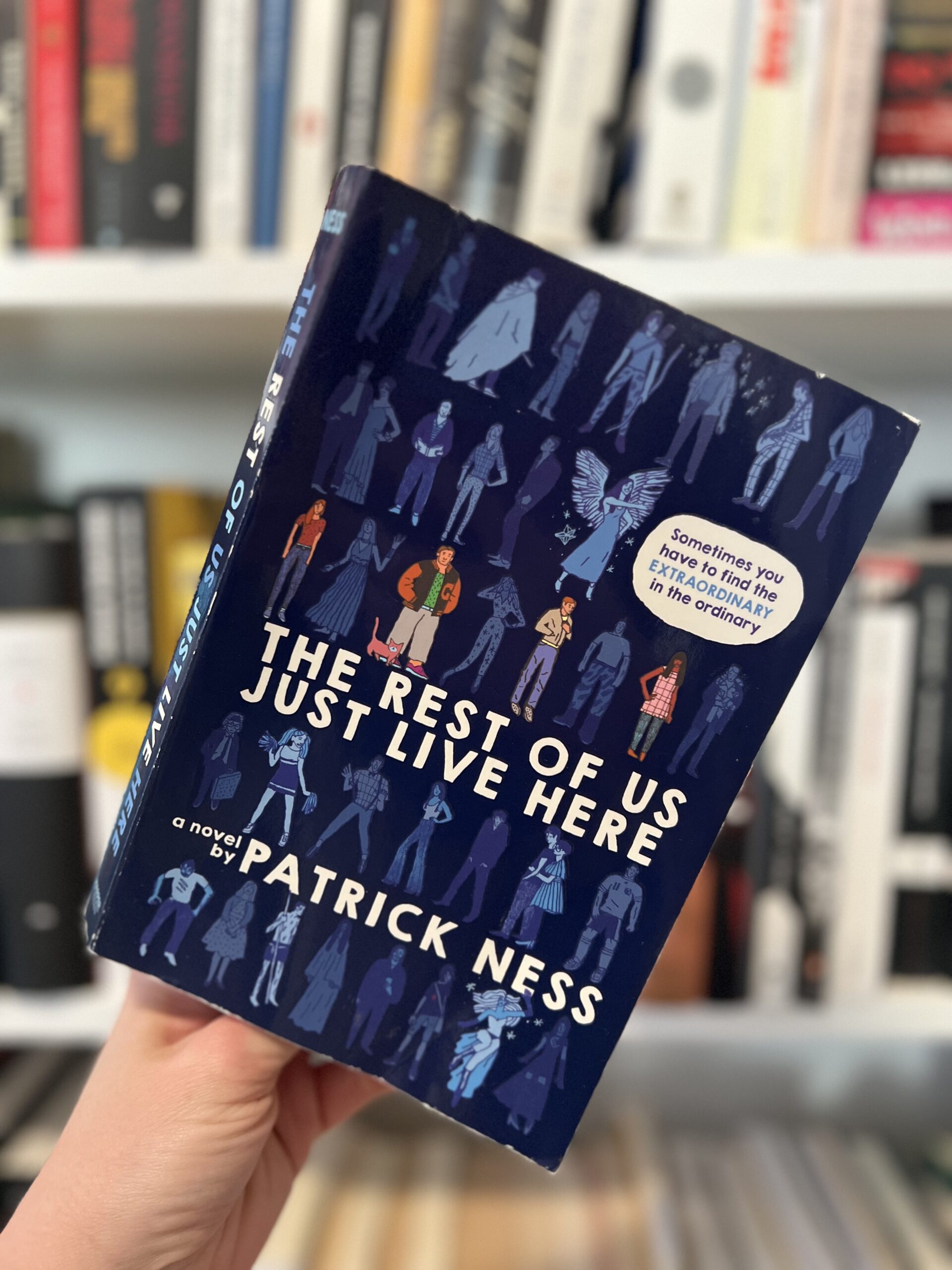
By Patrick Ness
“‘Look, Mike, most Gods don’t care.’
‘About what?’
‘About anything. Other than gaining dominance over other Gods and telling you how wonderful they are and demanding that you say the same.’ There’s some feeling in his voice when he says it. ‘There’s nothing like a bunch of Gods to show you how alone you really are.’”
Summary
This is the story of ordinary Mikey, a high school senior, who lives in a world where indie kids experience fantasies and atrocities in the periphery. He wonders if he’ll make it to graduation, and wants to know if the crush he has always had on his friend Henna will ever go anywhere, or if she’ll be swooped up by that evil new kid, Nathan. He’s worried his small, dysfunctional family might not survive his mother’s latest run for office. His best friend, Jared, three parts God, one part Jewish, hasn’t been himself lately. So focused on everyone else’s problems, Mikey begins neglecting his own, and his OCD behaviors start creeping back into his life.
Quick Info
- Year of Publication: 2016
- Number of Pages: 336
- Awards/Nominations: Michael L. Printz Award, CILIP Carnegie Medal, ALA Best Fiction for Young Adults, Kirkus Best Book of the Year, VOYA Perfect Ten, NYPL Top Ten Best Book of the Year for Teens, CPL Best Teen Book of the Year
Why I Chose to Read The Rest of Us Just Live Here
I was looking for a book for students who aren’t seeking conventional, heroic stories. This one came highly recommended.
Teaching Considerations
Audience: Booksellers list this as “14+.” There is death and fantastical violence. There’s also cursing and some underage smoking/drinking. The main character’s father has addiction issues. The author does a great job picking a strong protagonist to guide readers through this.
Key Themes: ordinary vs. extraordinary people, mental health, friendship, family, identity, love, longing, LGBTQIA+, and meaning.
Grouping Recommendation: This would be a fun student-choice book for a full-class unit on fantasy, modern YA, or mental health in literature. I could also see this being a fun book club selection.
Instructional Ideas:
CHARACTER
This is Mikey’s story, and his arc is well-constructed and emotionally weighty.
Ness skillfully created a set of four imperfect, great friends: Mikey, Mel, Henna, and Jared. Their clingers-on, Nathan and “Call Me Steve,” are rootable, too.
The parents in this world are distant, flawed, seen from the kids’ perspective, and interesting. Even the most beloved parent of them all makes mistakes.
We only get to know the indie kids superficially, as the author intends.
FANTASY
As a self-proclaimed fantasy book hater, who picked this book up not realizing it’s a smart fantasy parody with plenty of fantasy built in, I’m surprised I enjoyed it. Well, most of it. The chapter intros that explained the indie kids’ adventures were so silly, surface-level, and chock full of names that I could not keep track and eventually just stopped attempting to make sense of them or retain the information. I’d bet that a fantasy reader would have been more impressed and humored by these. However, I liked the variety and randomness of the book’s fantastical elements. It added intrigue and kept me guessing.
Key Excerpts
“CHAPTER THE FIFTH, in which indie kid Kerouac opens the Gate of the Immortals, allowing the Royal Family and its Court a fissure through which to temporarily enter this world; then Kerouac discovers that the Messenger lied to him; he dies, alone.” – page 53
What do you make of the indie kids? Do they symbolize anything? Do they have emotional arcs? Do any of them or their stories stand out to you? Why?
“It turns out that both the slight fascists and the pot farmers who live on our road are equally nice in a car accident.” – page 63
Is there anyone in this book whom Ness does not humanize? Who? How so?
“Mel: I don’t trust ANYONE who doesn’t need therapy.
Me: You don’t trust anyone period.
Mel: I trust you.” – page 161
How does this book explore mental health? Give examples. What do you think the author is hoping to convey?
Book Talk Excerpt:
“‘I’m in love with you, Henna.’
She smiles a bit at that, looking as surprised at the smile as I am at my words.
‘Mikey,’ she says, “I don’t think you are.’
Then she screams at the deer that’s jumped out of the trees and onto the road in front of us and there’s no time to even brake and we hit it, taking its legs out from under it, which everyone in these parts knows is the worst thing that can happen when you hit a deer, because now six hundred pounds of panicked, dying, unstoppable deer carcass are flying right up the hood, straight at us—
This is how people die, I think, in that instant—
And Henna and I are both ducking to the middle of the seat and our heads hit together with a funny coconut sound and glass is breaking and metal is bending above us (which is so loud, so loud) and something hits me hard in the cheek and I hear Henna make a soft ‘oof’ sound and her body shifts away from mine and it’s only now I realize the car is still moving and I reach over her to try to steer but the steering wheel has snapped off and I feel us veering and tipping and we come to a slamming stop and the passenger’s side air bag goes off so ferociously I actually feel my nose breaking.
Then it’s quiet.
‘Henna?’ I say. ‘Henna!’
Her voice, when it comes, is deep and guttural, pain-filled. ‘My arm,’ is all she says.
I pull myself up to an almost-sitting position. Rain hits my face. The roof of Henna’s car is peeled nearly all the way off. We’re pushed up against the dashboard and I turn my neck (ow, ow, ow) to see that the deer somehow went all the way over the top of us, which is some kind of freaking miracle. Its bulk takes up the entire back seat, its neck is broken, its dead weight pressing against us. The engine stopped when we drove into what I now see is a ditch, and I can hear movement all around us.
I must be in shock. Dozens of deer, dozens of them, are leaping out of the forrest on our side of the road, crossing it, and disappearing through the tree line on the other side.
They keep coming. I’ve never seen anything like it. It’s unreal.
‘Mikey?’ Henna says, her eyes wide with fear and the same shock as she sees what I’m seeing. Her left arm looks awful, twisted in a horrible way, so I take her right hand and hold it, as the impossible flood of deer spills around us like we’re an island in a river.” – pages 59-61
Interested in reading? Check out the book!
My Thoughts and Reflections
★★★★★
I appreciated the depth of Mikey’s story, the teenage uncertainty and exploration, the messiness of it all, including the parents. Ness even managed to make me feel for Mikey’s addict, crook father. Oddly, he was one of my favorite characters. This was the most realistic fantasy book I’ve ever read, and maybe that’s why I enjoyed it. I’ll definitely recommend it to young people in the future.
Topics/Ideas/Books/Authors I’m Curious About As A Result of Reading The Rest of Us Just Live Here
I’d like to read Ness’ book, A Monster Calls. This was actually on my list of books to read, and I didn’t realize it was the same author. Ness is very strong at illustrating parent-child relationships in an honest, probing, and powerful way. I wonder what that will look like in a story about a son grappling with his mother’s cancer. It looks like Ness adapted this for the stage and screen. Might be fascinating to see how his work changes from format to format.
Leave a Reply