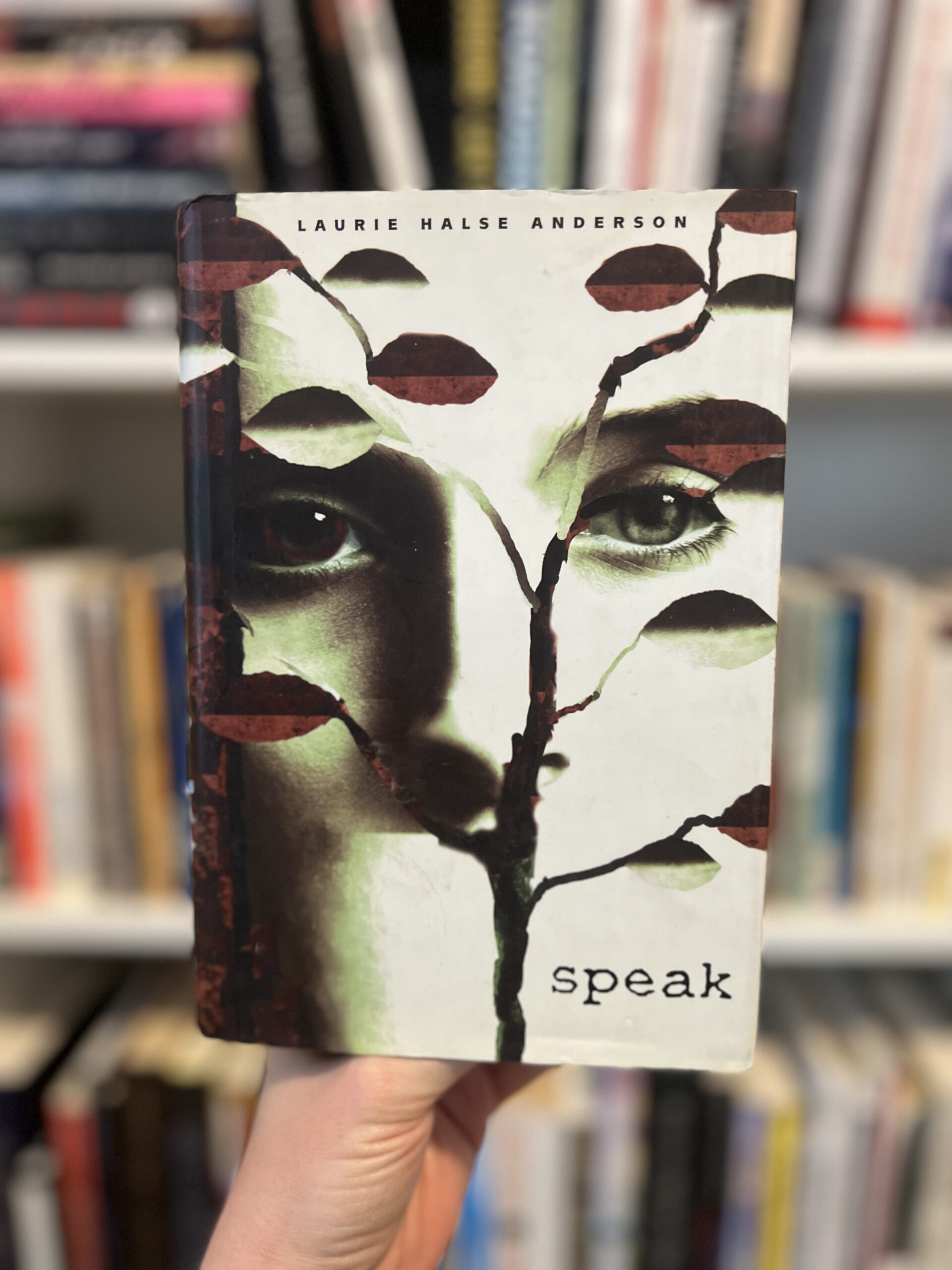
By Laura Halse Anderson
“Me: ‘Can you buy some seeds? Flower seeds?’”
Summary
This is the story of Melinda, an outcast high school freshman, due to an incident over the summer when she called the cops at a party, causing the other students to dislike her. The book covers her entire first year as she attempts to make new friendships, repair some broken ones, and make it through each day’s classes. She must also face IT, the thing that happened, the reason she made the 9-1-1 call. And that’s the hardest part, because she’d rather hide under blankets or in the abandoned janitor’s closet or in art projects for the only class she’s passing, much to her parents’ dismay.
Quick Info
- Year of Publication: 1999
- Number of Pages: 224
- Awards/Nominations: National Book Award Finalist, BCCB Blue Ribbon Book, SCBWI Golden Kite Award for Fiction, Horn Book Fanfare Best Book of the Year, ALA Best Books for Young Adults, Printz Honor Book, YALSA Fiction Quick Pick for Reluctant Young Adult Readers, Edgar Allan Poe Best Young Adult Award Finalist, 2001 New York Times Paperback Children’s Best Seller, 2005 New York Times Paperback Children’s Best Seller
Why I Chose to Read Speak
I have PTSD from sexual trauma I experienced as a young person. I’m grateful for books like this, which encourage survivors to speak up!
Teaching Considerations
Audience: Booksellers list this as “12+.” Agreed! (Appreciate the middle school inclusion.) The narrator does, at times, demean others and use language like the R-word, which felt unnecessary, but true to the ignorance of youth.
Key Themes: rape, trauma, identity, voice, friendship, dysfunctional family, teachers, and learning.
Grouping Recommendation: This could be a focal book for a full-class unit with bridged texts. I could ask students to read it and compare/contrast it with a book of their choice based on subject matter they believe is crucially important for young people to read.
Instructional Ideas:
CHARACTER
The author pulled off a miracle, honestly portraying a somewhat unlikable character at the start and keeping us close to her throughout the year as she sheds a bit of her trauma, becoming more and more accessible and powerful.
This book lived inside the high school. It explored a wide variety of teacher-student experiences, and Mr. Freeman’s character was exactly the kind of support (from a trusted male) Melinda needed. He reminded me of some of my best teachers.
The other girls in the book were unraveled with grace and empathy.
IT was horrifying.
Melinda’s parental situation was also upsetting, sad, and true to her story.
STORY
A young woman finds her voice after losing it during and after trauma.
STRUCTURE
The book is divided into four “marking periods,” each with progress report cards and school mascot identity changes. Except for the final period, where Halse Anderson allows Melinda’s actions to speak for her identity and progress.
Key Excerpts
“I see IT in the hallway. IT goes to Merryweather. IT is walking with Aubrey Cheerleader. IT is my nightmare and I can’t wake up” – page 45
What is the author doing here? Could she have described this character in any other way? Why do you think she made this choice? How does it serve the book?
“The first thing to go is the mirror. It is screwed to the wall, so I cover it with a poster of Maya Angelou that the librarian gave me. She said Ms. Angelou is one of the greatest American writers. The poster was coming down because the school board banned one of her books. She must be a great writer if the school board is afraid of her. ” – page 50
Who is Maya Angelou? What has she written? Why is her poster perfect for its sacred space in Melinda’s safe closet, where it covers the mirror?
“The high point of the assembly is the announcement of our new name and mascot. Principal Principal reads the vote total: Bees—3. Icebergs—17. Hilltoppers—1. Wombats—32. The other, 1,547 votes were write-ins or illegible.” – page 69
How does the school’s inability to settle on a name and mascot serve this story? Why does the author include it? What context clues informed you?
Book Talk Excerpt:
“TEN MORE LIES THEY TELL YOU IN HIGH SCHOOL
- You will use algebra in your adult lives.
- Driving to school is a privilege that can be taken away.
- Students must stay on campus for lunch.
- The new textbooks will arrive any day now.
- Colleges care about more than your SAT scores.
- We are enforcing the dress code.
- We will figure out how to turn off the heat soon.
- Our bus drivers are highly trained professionals.
- There is nothing wrong with summer school.
- We want to hear what you have to say.” – page 148
What do you think about these rules? Do you like the narrator? What do you think about her? How do you know? Halse Anderson is not a high school freshman. How well do you think she captured the voice/silence of a young woman?
My Thoughts and Reflections
★★★★★
I rarely, if ever, cry while reading books. This one ended with a good cry, and I’m grateful to Halse Anderson for writing it and for paying tribute to Maya Angelou while doing so. I wish my teachers would have shared this book with me in middle and/or high school
Topics/Ideas/Books/Authors I’m Curious About As A Result of Reading Speak
I’ve never read I Know Why the Caged Bird Sings. I’ve heard of it, of course, but due to my traumatic experience, I didn’t want to open it up when I was younger. Now, I’m ready. I’m willing to read anything that might help a student.
Twisted, The Perks of Being a Wallflower, and The Knife of Never Letting Go all look like promising male-centered YA books that tackle similar trauma.

Leave a Reply