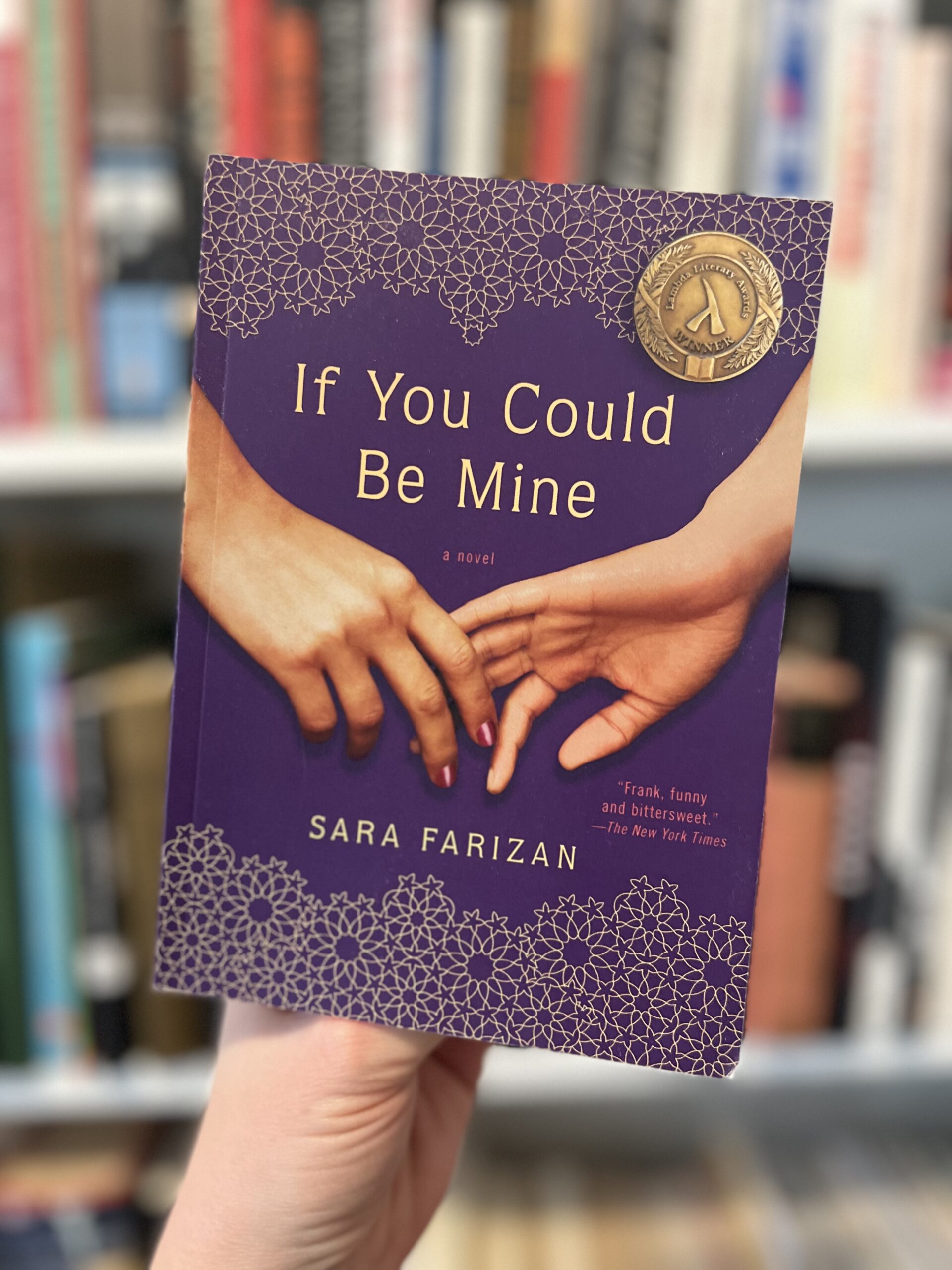
By Sara Farizan
“‘All right, I love y—.’”
Summary
This is the story of Sahar, a witty, intelligent, working-class Iranian teenager who is in love with her affluent, beautiful childhood friend, Nasrin. The love is mutual but complicated, challenged by a society that refuses to accept it. When Nasrin gets engaged to Reza, a successful doctor-in-training who is also genuinely sweet and kind, Sahar must decide how far she is willing to go to hold on to the person she loves. If You Could Be Mine explores love, identity, and the painful choices imposed by a society that demands conformity, while offering a nuanced portrait of a wide spectrum of LGBTQIA+ identities and beliefs.
Quick Info
- Year of Publication: 2013
- Number of Pages: 248
- Awards/Nominations: Lambda Literary Award, Ferro-Grumley and Edmund White Awards, Rolling Stone: One of the 40 Best YA Novels, ALA Rainbow List: Top 10 Title, Booklist: Top 10 First Novels for YA, Chicago Public Library: “Best of the Best”
Why I Chose to Read If You Could Be Mine
Last year, while planning a trip with an organization I work with, a woman I look up to explained that she doesn’t travel to Iraq due to the risks of being queer. It made me wonder how many nations have laws against homosexuality. I read this, hoping to gain a greater global perspective, one I could share with students.
Teaching Considerations
Audience: Booksellers list this as “grade level 7-9.” It’s possible I will never understand maximum age recommendations. To me, for older students, this book could catalyze much deeper learning.
Key Themes: Love, friendship, identity, oppression, survival, class differences, internalized shame and fear, agency, and alternative support systems.
Grouping Recommendation: I would love to teach this book as a full-class lesson. It’s the perfect length and packed with tension and drama to keep students engaged. It explores the global LGBTQIA+ community with honesty and respect. (No, not every character is respectful, but the full, honest picture is.) The humorous narration will likely make it enjoyable and accessible for all. To incorporate student choice, I’d ask each student to pair it with a book to compare and contrast in a culminating essay. I would offer a few optional essay topic examples and support them in developing their own thesis statements.
This would also be an obvious choice for a student-led Banned Book club, but relegating it to “extracurricular only” would be a shame.
Instructional Ideas:
CHARACTER
Farizan trusts her characters and her readers. She never explains too much. She builds her characters through their actions and uses subtext smartly to give readers greater insight into who all these people really are. She gives them all compelling flaws, and invites us to love them all, as they wrestle with who they are and who they want to be in a society where acceptance and inclusion are transparently atypical.
I thoroughly enjoyed reading Sahar’s narration. This is a naive, intelligent, flawed, funny character, an underdog in Iranian society, who lives with integrity.
Nasrin and Ali strike me as characters many readers will dislike. Though I wonder what a young person born into their bodies might do in similar circumstances…
Reza is sweet, smart, and Nasrin’s prince charming. Poor schmuck. Of course, we love him. And Farizan engineers twists throughout, further endearing him to us.
Sahar’s widower father and Nasrin’s mother offer wider perspectives and added tension. It’s fascinating to watch Sahar say too much to Nasrin’s mother, and keep so much hidden “to protect” her father.
Goli khanum, the respected queer elder, and her group offer a nuanced look at LGBTQIA+ individuals and outcomes in Tehran.
Farshad, the police officer, offers a taste of bureaucratic corruption and hypocrisy.
STORY
I adore the way this book subverts the romance genre and how Farizan architected the perfect, imperfect love triangle. To me, without spoiling the ending, this makes sense of why some characters are less rootable than others.
This is also the story of Sahar and her father, who are learning to live again after the death of Sahar’s mother.
More than anything, this book about romantic, unconventional love ultimately champions self-love. I can’t think of a more important theme for young readers.
Key Excerpts
“‘I’ve never been arrested,’ Daughter says, and I put my hand over her shaking ones. ‘I’ve heard stories of what happens.’” – page 189
“‘Nastatran. My name is Nastaran.’” – page 191
What do you make of the character Daughter/Nastaran? What do we know about her and Mother? What do we assume? Why do you think their story is included in this book?
“‘You are so like your mother,’ she says. ‘She lost everything to be with your baba. Her wealth, status, family—and she never looked back.’” – page 228
In large part, this is a book about class. Can you point to a few examples of characters embracing societal expectations and a few where characters rebel? What are your thoughts on class? Is the USA any different from Iran? Are you sure? Explain your thinking.
Book Talk Excerpt:
“Baba sits on my bed and touches my shoulder. ‘Your teacher said your grades have gotten worse. I didn’t know what to tell her. Your grades have always been excellent. Even in preschool you were obsessed with knowing the right words to nursery rhymes.’ I don’t care if he’s disappointed. Maybe I figured out there is no point to schoolwork. I’ll still be a huge lesbian without a girlfriend. He lets go of my shoulder. Good. I hope he’s finished.
‘Should I call Nasrin to come over?’
I start hysterically laughing. I sit up and look at him. He is so confused. He knows exactly who I’ve always needed in times like this. But he can’t know that right now, Nasrin might be the last person I want to see. I’m starting to cry from laughing so hard, and Baba looks concerned.
‘Call Nasrin?’ I ask. ‘Do you want to know why my grades are suffering? Why I skipped school? Why everything has stopped making sense?’ I want him to know. I want him to know me, to know what I have painfully and silently been dealing with. ‘Do you want to know what Nasrin does when she comes over here that makes me feel so good?’ Won’t he be surprised to know his daughter is an enemy of the state, a lowlife, and an aberration from God’s plan.
‘She listens to you?’
The anger leaves me. He looks so helpless and innocent, like a sheep that’s about to be slaughtered for the end of Ramadan.
Maybe that is why I am so devoted to her. She listens to me.” – page 181-182
How does Sahar and Baba’s story reinforce the greater narrative? What does it tell you about Sahar? Can you relate?
My Thoughts and Reflections
★★★★★
Though this is a sad book, the author included hilarious narration from the protagonist’s perspective, making it a really enjoyable dramedy. It was short, sweet, and tension-packed. All characters were well-crafted and rootable (including the notorious Nasrin and transgressive Ali, who, to me, are just kids, deserving of grace). This book also offered an in-depth, honest, respectful illustration of the complexities of the global LGBTQIA+ community. It was one of my favorite reads of the year. I’ll recommend it to students and beyond.
Topics/Ideas/Books/Authors I’m Curious About As A Result of Reading If You Could Be Mine
We Have Always Been Here: A Queer Muslim Memoir by Samra Habib is a highly acclaimed non-fiction book with similar subject matter.
Also, I’d like to read more of Sara Farizan’s work. Tell Me Again How A Crush Should Feel, Here to Stay, and her short story in Night of the Living Queers: 13 Tales of Terror & Delight look appealing. I truly think If You Could Be Mine would make a fantastic film, and I’m surprised that it hasn’t been adapted for the screen.

Leave a Reply