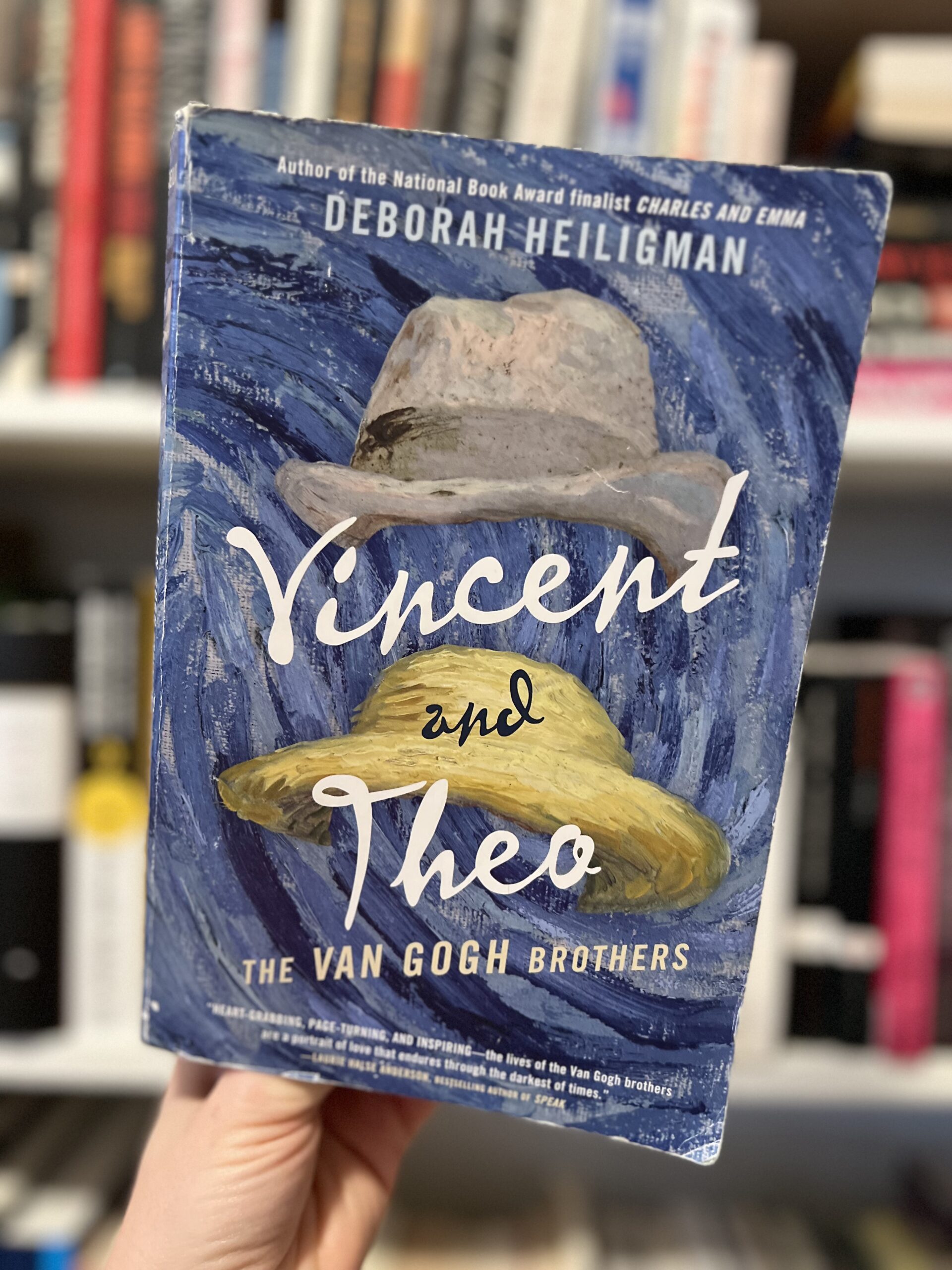
By Deborah Heiligman
“THE VIEW depends on the perspective.”
Summary
Vincent and Theo: The Van Gogh Brothers is a well-researched nonfiction account of Vincent’s decision to pursue drawing and painting at all costs and his devoted brother Theo’s decision to support, challenge, and champion him. Both of them come from a big, affluent family and are forced to question classism. Both of them battle unrequited love and mental and physical health issues. Sometimes they adore one another, and other times they can’t stand to look at each other. Always, their loyalty to one another prevails.
Quick Info
- Year of Publication: 2017
- Number of Pages: 464
- Awards/Nominations: Printz Honor Book, YALSA Nonfiction Award Winner, SCBWI Golden Kite Winner, Boston Globe–Horn Book Awards Winner, Nonfiction, Cybils Senior High Nonfiction Award Winner
Why I Chose to Read Vincent and Theo: The Van Gogh Brothers
Lust for Life was one of the first books I read and loved as a kid. However, booksellers list it as 18+ due to mature themes. I was curious to see if this YA nonfiction book could capture some of the inspiring, creative magic of Irving Stone’s not-quite-nonfiction novel.
Teaching Considerations
Audience: Booksellers list this as “14-18 years.” I don’t understand why they cap it at 18. 12+ makes sense to me, as it’s tactful and potentially creativity-catalyzing.
Key Themes: brothers, art, the cost of art, God, family, mental health, sacrifice, codependence, legacy, and love.
Grouping Recommendation: I would 100% recommend this to creative students for individual reading.
As a full-class assignment, I’d love to print an excerpt from this, an excerpt from Lust for Life, and a letter written by Vincent Van Gogh for comparative value and creative writing inspiration.
I’d love to dive into a sports legend lesson before or after the Van Gogh lesson, so students can compare and contrast driven athletes and artists.
Instructional Ideas:
STRUCTURE
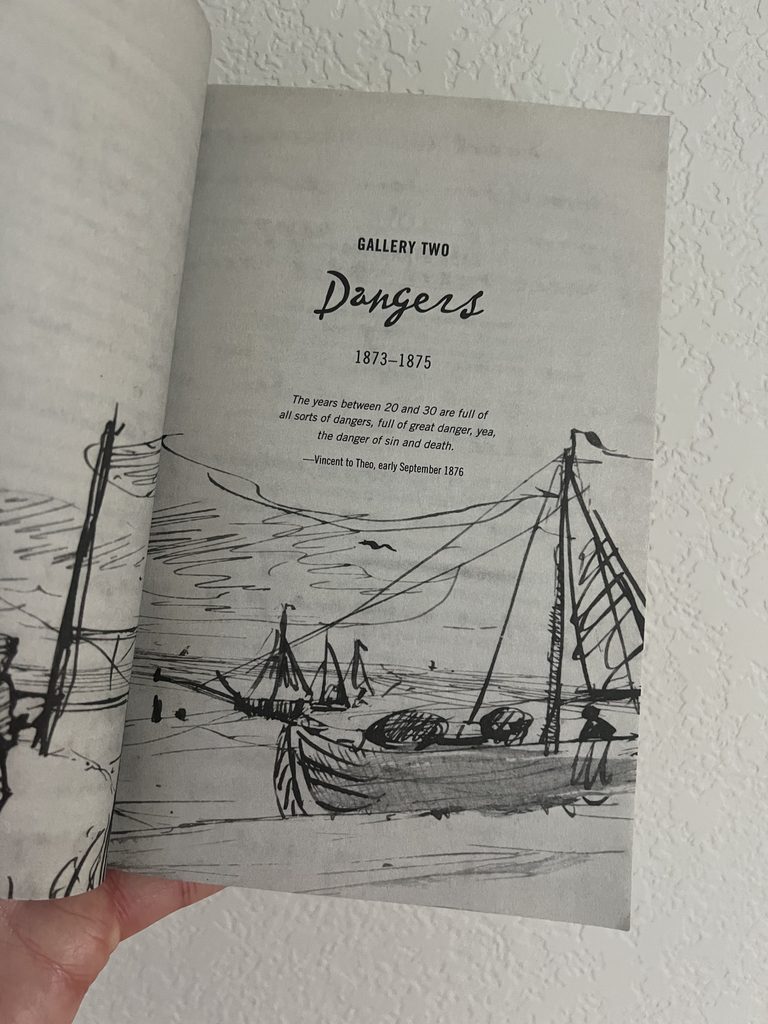
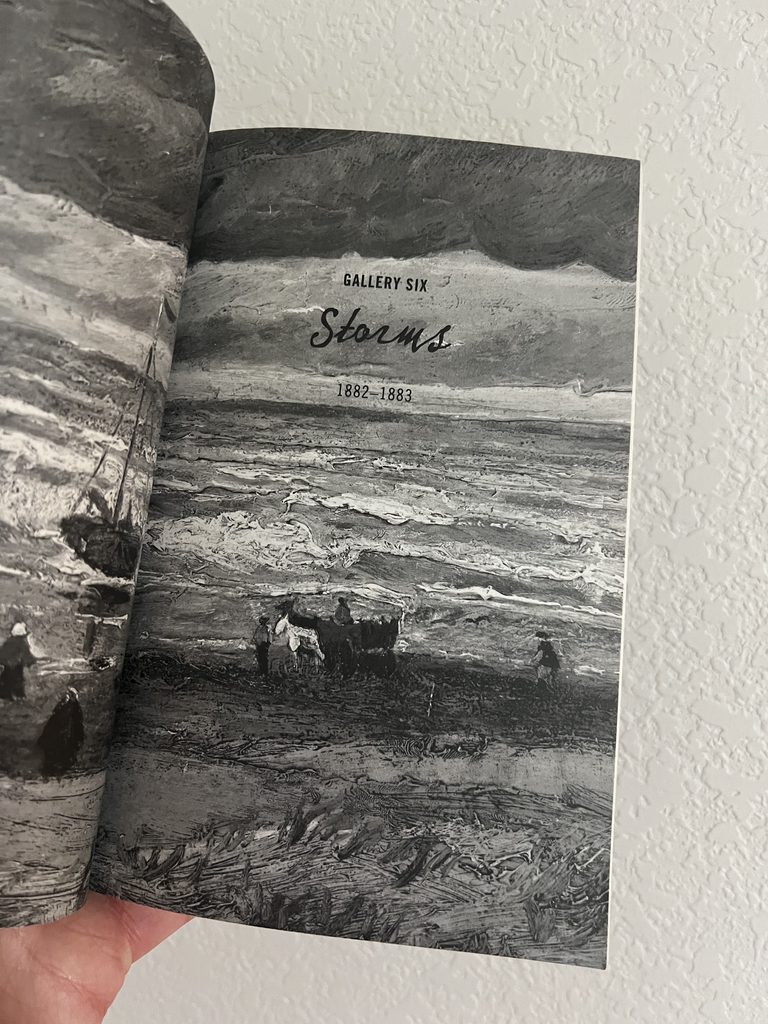
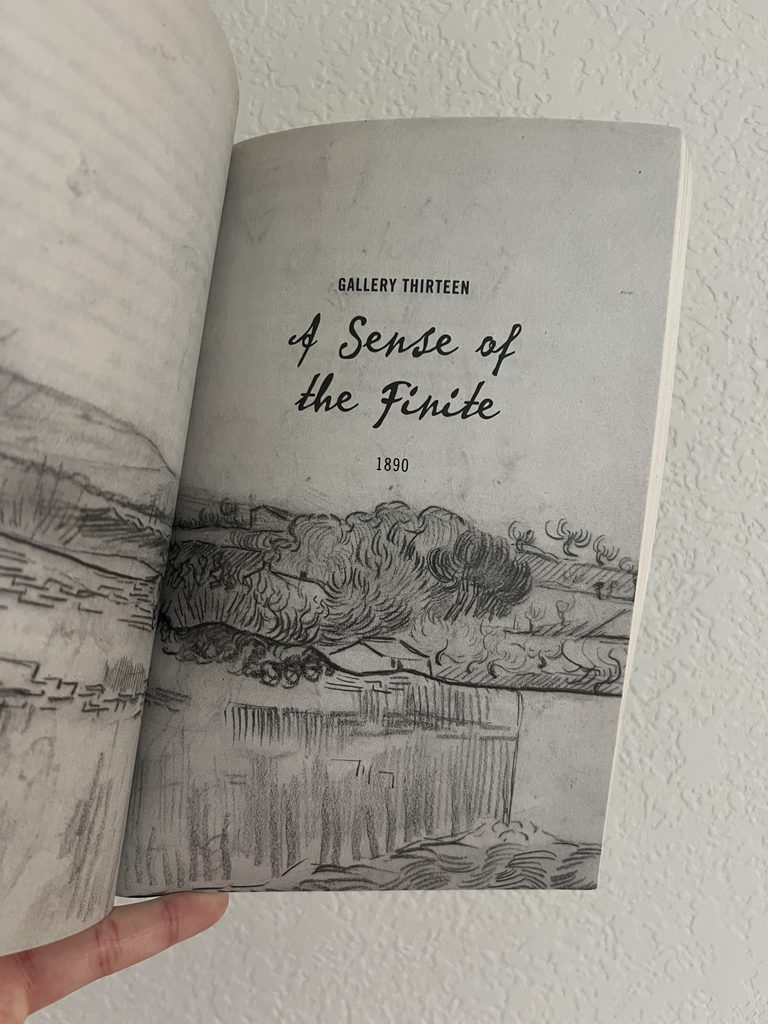
Heiligman first pulls readers in with a conflict-ripe anecdote of Theo and Vincent living together, the Threshold. From there, she brings us to the Entresol for one of the most notorious moments in Vincent’s life, after his ear has been cut off, when Theo is at his hospital bedside. Then, whoosh! Heiligman pulls us into the past and tells the brothers’ life story in chronological order via Galleries One through Fourteen. Finally, she gives us an insightful, unforgettable Exit. The chapters are short and sweet, and there are 121 of them! There’s also a midsection with art.
STORY
Unsurprisingly, this is about Theo and Vincent Van Gogh, an art dealer and an artist, whose bond is powerful and enviable. The author does a great job unfolding the emotional story with surprising twists and turns. Especially in moments when readers fear for both brothers’ health and for the health of their vulnerable family members and friends.
CREATIVITY
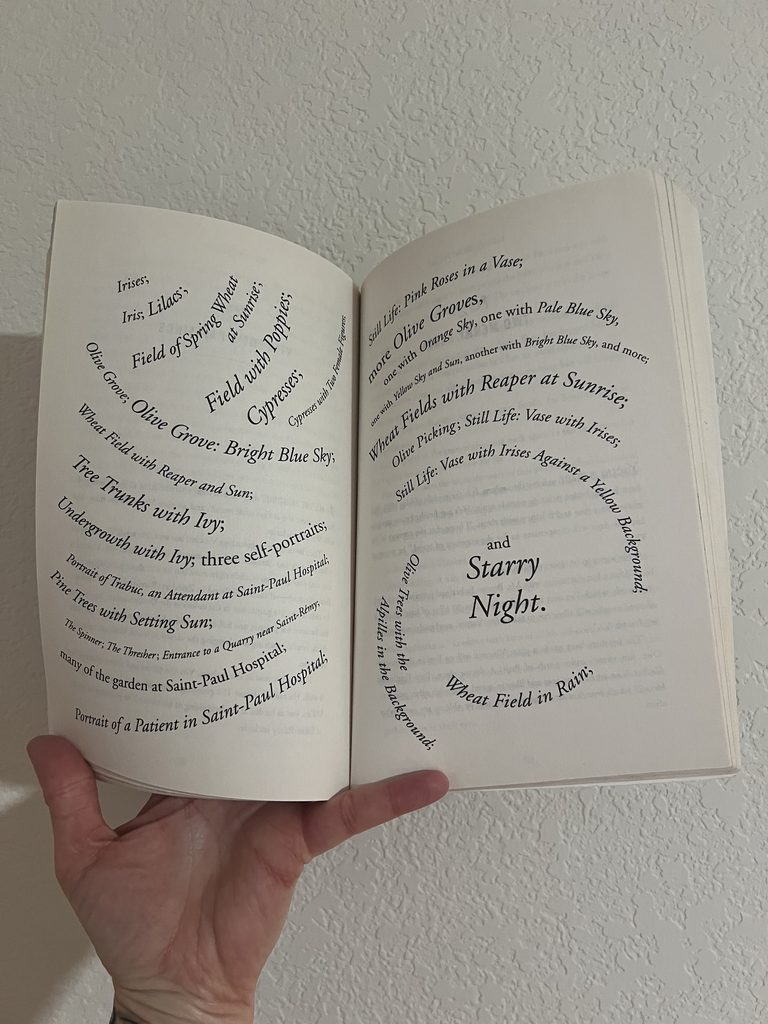
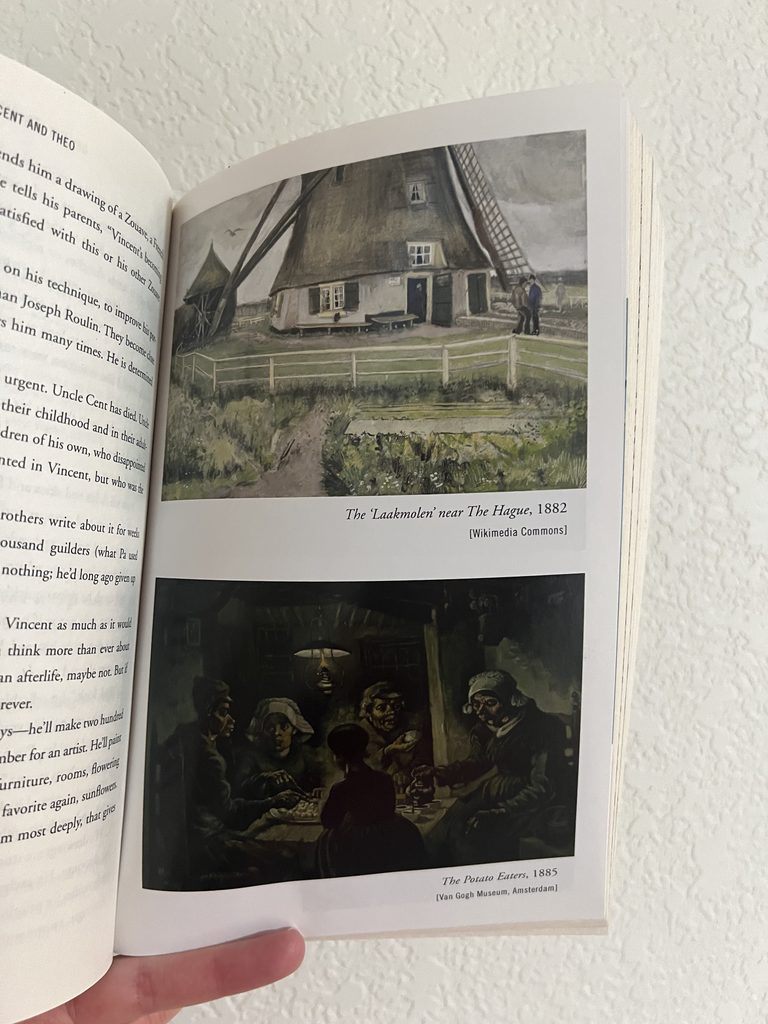
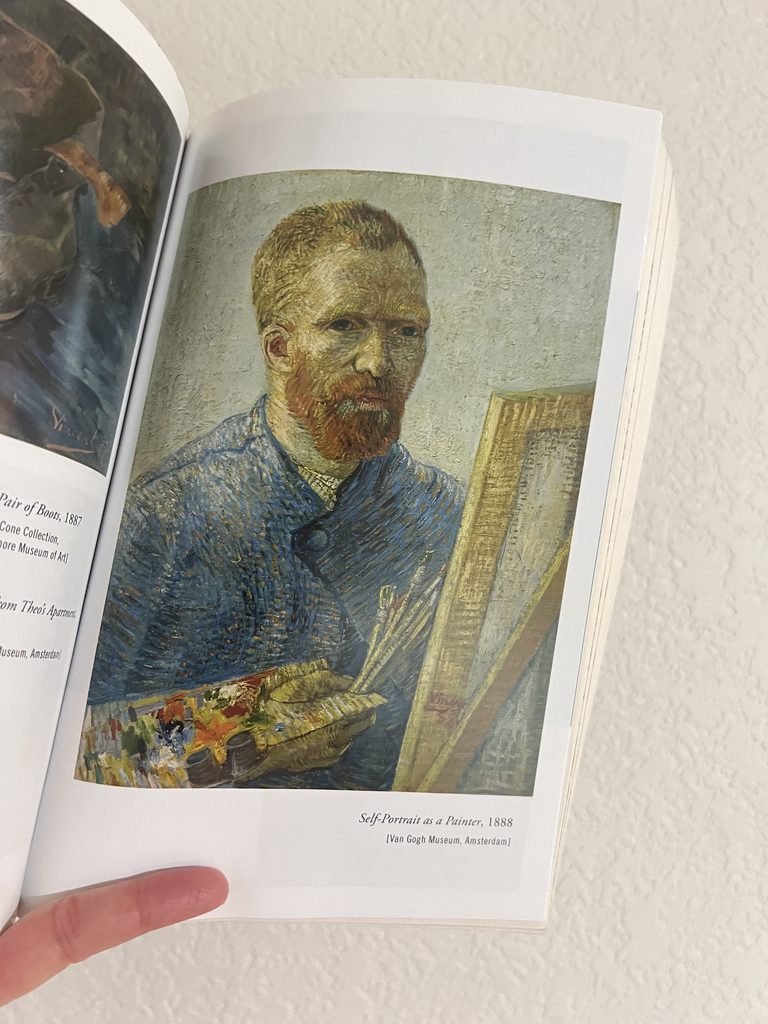
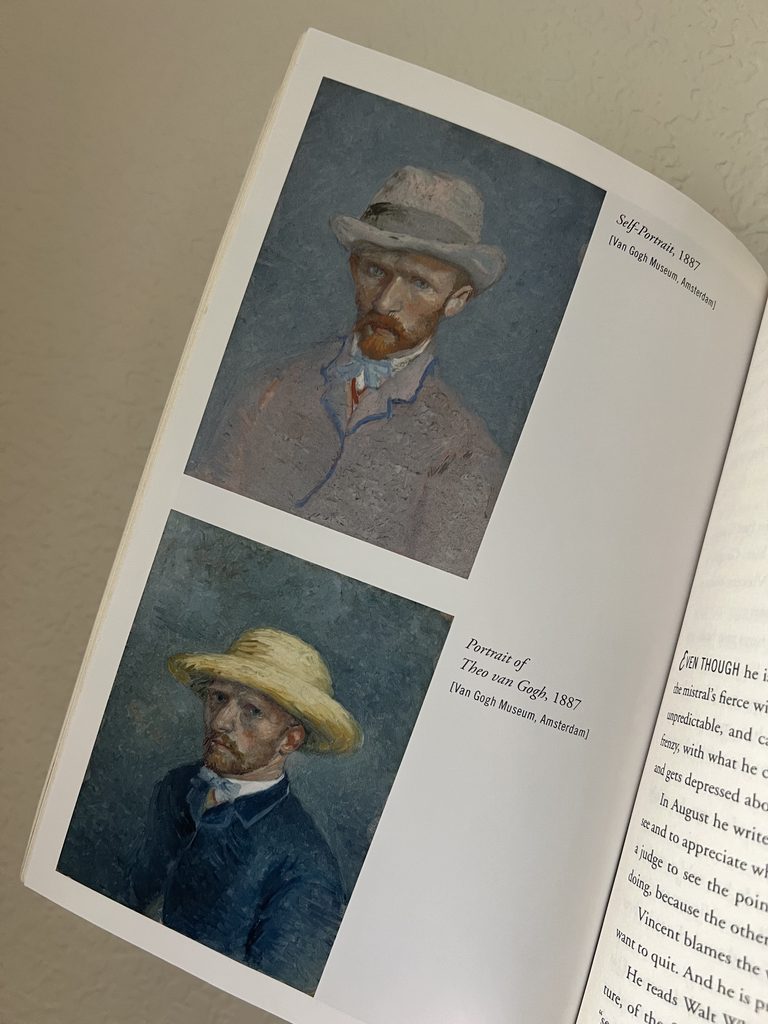
As you can see, the book was published so that form is truly cohesive with content.
Key Excerpts
“And something else is wrong with Vincent. Something inherited, he thinks. Vincent knows there are members of the family who suffer from melancholia, from mood swings, extreme behavior, eccentricities. He’s always been different. Even odd. Now, as a young man, he fears he is suffering from some kind of problem in his mind. Vincent is right. He has inherited something. We can’t go back in time and diagnose him, but from here it looks like a form of epilepsy or, most likely, the beginnings of bipolar disorder, which is also known as manic depression.” – page 66
How does this book explore mental health? What are its strengths? Weaknesses? How does this account make you feel? Do you like the protagonists? Are they rootable? Why or why not?
“From Paris to Nuenen and back, Vincent and Theo send each other books about color and color theory. They read about the phenomenon of simultaneous contrast of colors, about complementary colors. Complementary colors, the brothers read, when they are placed next to each other, reinforce each other. They make each other stronger.” – page 221
Do you think Deborah Heiligman has experience as an artist? Why? Can you point to excerpts that might show she is either an artist, has an art background, or has done extensive research?
Book Talk Excerpt:
“It is early March 1880. Vincent is broke, hungry, alone. But he has pulled himself out of his darkness enough to take yet another very long walk.
He is traveling from the Borinage to Courrières, a coal-mining town in northern France. It is about fifty miles away.
He doesn’t have a real plan. He just feels he must see Courrières. Maybe he’ll find work. He hopes to meet a painter who lives there. He has only ten francs and uses almost all of it to buy a train ticket to take him partway. Then he walks the rest of the distance, some twenty-two miles, trudging ‘rather painfully.’
When he arrives in Courrières, he looks for the studio of the painter Jules Breton. Vincent finds the studio, but he just stands outside looking at the building. The facade disappoints him. It is new, made of brick. It doesn’t look to Vincent the way an artist’s studio should look; it seems to him cold and inhospitable.
He admires Breton. He should knock, he knows. But he can’t summon the courage to introduce himself.
And so he walks away from Breton’s studio, not even trying to meet the man he came to see. Instead he looks around town for other traces of the artist. He finds none of Breton’s paintings, only a picture of him at a photographer’s shop.
With only two francs left, he cannot take the train back to his home in Borinage. So he walks the whole fifty miles. It rains; it is windy. He has to bivouac out in the open for three nights.
He is at the end of his possibilities and, as he will tell Theo later, is at ‘a point of destitution such that one doesn’t even have a roof over one’s head and must tramp on and tramp on like a vagabond into infinity without finding either rest or food or shelter anywhere, moreover without the possibility of doing any work.’
But.
Vincent has brought with him some drawings he made. Those drawings become his currency.
‘I earned a few crusts of bread en route here and there in exchange for some drawings that I had in my suitcase.’
Vincent has just begun his art career.
But he doesn’t know it yet.
No one does.” – page 119-120
How do you think a human builds a legacy? Do you want to build one? Why or why not? Explain.
My Thoughts and Reflections
★★★★★
I can’t imagine a high school student wanting to read this long, historical book unless they’re a true art geek! Being an art geek, and an art geek with an audiobook to pair with my print copy, I became so enraptured that I put down just about everything else in my life to finish it in two days. I adore most people who devote themselves to art, like Vincent. I acknowledge how I wouldn’t know Vincent without Theo. And I’m obsessed with the admission at the end of the book, which explains how I wouldn’t know either of them if it weren’t for a sharp, bold, loyal, courageous third party. Yes, part of me gets nauseous while reading about two affluent white guys “suffering” while spreading syphilis all over Europe. Another part of me can’t help but love this brilliantly researched story about brothers, love, suffering, and art.
Topics/Ideas/Books/Authors I’m Curious About As A Result of Reading Vincent and Theo: The Van Gogh Brothers
I’d love to pair Courage to Soar with clips from Simone Biles Rising and some of her social media statements. I’ve seen the documentary, but haven’t looked at all else. Again, I believe a sports legend lesson would be great to teach before or after the Van Gogh lesson, as it could help unlikely students in the classroom connect, empathize with, and celebrate one another.

Leave a Reply