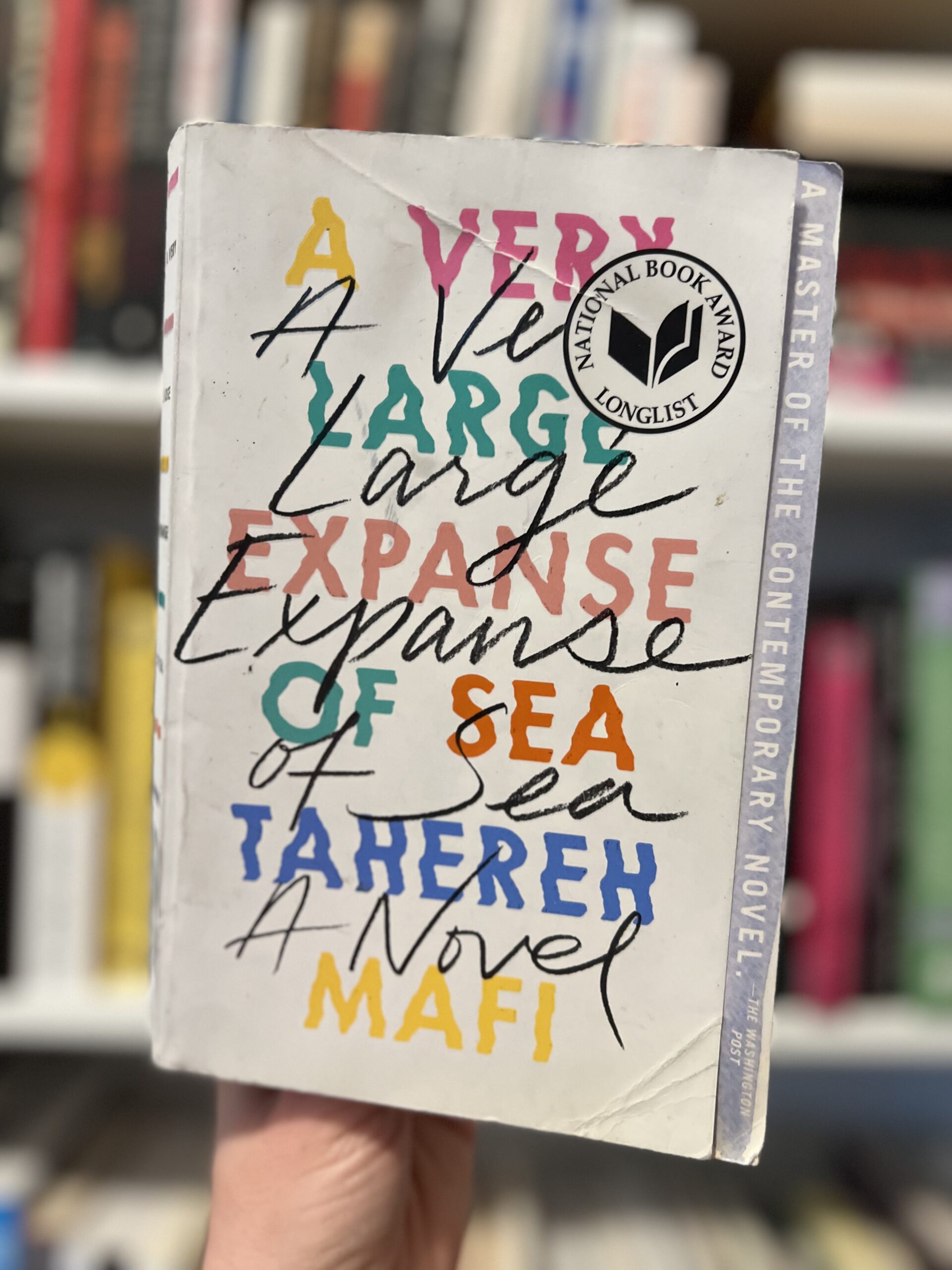
By Tehreh Mafi
“I wondered, for the very first time, if maybe I was doing this whole thing wrong. If maybe I’d allowed myself to be blinded by my own anger to the exclusion of all else. If maybe, just maybe, I’d been so determined not to be stereotyped that I’d begun to stereotype everyone around me.”
Summary
A Very Large Expanse of Sea takes place just after 9/11 in the United States and follows Shirin, a guarded high school sophomore whose Iranian immigrant family is constantly on the move. While Shirin protects herself from relentless Islamophobia by shutting people out, her charismatic brother Navid navigates the same world with openness, and the two fiercely support one another. During this chapter of their lives, they form a breakdancing crew, giving Shirin a rare outlet for her anger and a sense of control. When she meets Ocean James, a white, popular, well-meaning high school basketball star who genuinely wants to know her, Shirin risks lowering the walls she’s built to survive. As their relationship deepens, the scrutiny and backlash they face reveal the social realities neither of them can escape. Ultimately, the novel explores a tender but fraught first love shaped by identity, prejudice, and the cost of vulnerability.
Quick Info
- Year of Publication: 2018
- Number of Pages: 320
- Awards/Nominations: National Book Award, Time Magazine Best YA of All Time
Why I Chose to Read A Very Large Expanse of Sea
Being born in suburban Colorado, I’d met zero Muslims from birth to age seventeen. A few years after 9/11, from age seventeen through my mid-twenties, I lived and worked in NYC with a variety of Muslims. These people were all wonderful, kind, hard-working, and they made my life richer. This experience also forced me to question the often xenophobic messaging I’d seen in popular media up to that point. I read this book to expand my understanding of Muslim perspectives, including YA stories I can recommend to students.
Teaching Considerations
Audience: Booksellers list this as “ages 13+.”
Key Themes: first love, vulnerability, Islamophobia, racism, resistance, identity, acceptance, siblings, family, cultural expectations, and subculture as escape.
Grouping Recommendation: While I might recommend this book, I’d like to pair it with at least one lesson on consent. As such, I likely wouldn’t recommend this for individual reading. This would be great for group reads or for dialogue journals between a pair of students who read the book simultaneously.
Instructional Ideas:
CHARACTER
Mafi managed to obliterate stereotypes while writing within the typical teen/high school framework, doing so through her characters. Shirin, Navid, and their parents prove that families in the U.S., whether immigrant or “native,” have more in common than not. (Even if U.S. citizens eat canned soup!) As Shirin navigates stereotypical xenophobic peers, she also calls her own tendency to stereotype into question. Then, Mafi counters the stereotypical white American attitude toward Muslims with Ocean, Shirin’s love interest. The breakdancing group provides a space of relief from suburban homogeneity. Amna, the only other Muslim female featured in the book, offers an alternate perspective. Mr. Jordan and the basketball coach are realistically imperfect. In fact, all of the adults in this book, Ocean’s mom included, might really resonate with young readers, who already know or could benefit from understanding that adults are works in progress, too.
STORY
At its core, this is the love story of Shirin and Ocean. Although published in 2018, Mafi sets the novel in the immediate aftermath of 9/11, creating a Romeo-and-Juliet–like tension shaped by fear, prejudice, and social pressure. In this context, their relationship highlights the very real human choice between bigotry and acceptance.
Key Excerpts
“No one even asked me the question anymore; people just assumed they knew the answer, and they were nearly always wrong. I dressed the way I did not because I was trying to be a nun, but because it felt good—and because it made me feel less vulnerable in general, like I wore a kind of armor every day. It was a personal preference. I definitely didn’t do it because I was trying to be modest for the sake of some douchebag who couldn’t keep his dick in his pants. People struggled to believe this, because people struggled to believe women in general.” – page 49
This book constantly challenges stereotypes. What are some stereotypes people have held against you? Have you held stereotypes against others? Why?
“The more I thought about it, the more the prospect of Ocean discovering these pages felt a bit like freedom.” – page 294
Oh, the notorious high school journal! The moment a writer introduces a young person with a journal, you know it’s going to be discovered… Hah!
So, how is the invasion of Shirin’s journal shocking or surprising? Was it okay for Ocean to read it without consent? What might have happened if he had misinterpreted what she wrote, or if she had written something different?
Write a short, 1–2 page piece that explores this idea. First, write a journal entry from one character’s perspective. Then, write a second piece from the perspective of someone who discovers and reads that journal. What’s their response? The second piece can be a journal entry or a short narrative detailing their reaction. Feel free to use historical figures, pop culture icons, yourself, or Shirin and Ocean to alter the outcome of A Very Large Expanse of Sea.
Book Talk Excerpt:
“It was right around lunch when things hit peak weird.
This random girl cornered me. It was fast. Totally unexpected. She just about knocked me into one of the outdoor picnic benches.
I was stunned.
‘Can I help you?’ I snapped at her.
She was a beautiful Indian girl. She had long, dark hair, and really expressive eyes, and she was using those eyes today to express to me that she wanted to kill me. She looked livid. ‘You are a terrible role model for Muslim girls everywhere!’ she said.
I was so surprised I actually laughed. Just once, but still.
I’d imagined today going badly in any number of different ways, but wow, wow, I had not been expecting this.” – pages 194 – 196
“My mornings were always something like this:
Navid and I fought over who got to shower first in our shared bathroom, because he always managed to make everything wet, and after he finished shaving he’d leave these tiny little hairs all over the sink and it didn’t matter how many times I told him how gross it was, he never seemed to take the hint. Still, he usually won the right to take the first shower because he had to be at school an hour earlier than me. My parents would then force both of us to come downstairs and eatbreakfast, during which time, my mother would ask us if we’d done our morning prayers and Navid and I would spoon cereal into our mouths and lie that we had, and my mom would roll her eyes and tell us to make sure we at least did our afternoon prayers, and we’d lie that we would, and my mom would sigh, heavily, and then Navid would leave for school.” – page 298
What, if anything, has Shirin’s perspective in this book taught you about Muslims? Who is a perfect Muslim? Christian? Jew? Buddhist? Hindu? Atheist? Why?
My Thoughts and Reflections
★★★★★
This was a really quick read for me, although I did find myself wrestling, at times, with a lack of desire to indulge in teenage romance. This could be partly due to my feeling conflicted about the grey areas of consent this book captured. Shirin often says no, but Ocean pushes for more through texts and physical contact. At one point, he even opens her locker and reads her journal. I realize the book’s purpose is to provide readers with insights into how complex it is for a young Muslim woman to navigate the world. I respect that. Still, I wasn’t comfortable reading those portions of the book. What I loved about this text was the strong, wise female protagonist who chose to wear a hijab for herself, who found a passion she invested in for herself, and who often articulately stood up for herself when confronted by peers and adults.
Topics/Ideas/Books/Authors I’m Curious About As A Result of Reading A Very Large Expanse of Sea
I’d like to read Nick & Norah’s Infinite Playlist, Sick Kids in Love, When Dimple Met Rishi, Born Confused, Zen and Gone, and Heretics Anonymous. Religious tolerance is important to me. I didn’t only grow up not knowing Muslims until I moved to NYC. I also didn’t know Jews, Hindus, Buddhists, Hare Krishnas, Mormons, etc. Humans share a giant world that’s increasingly more connected. Why not do our best to understand one another and live in peace?
Leave a Reply