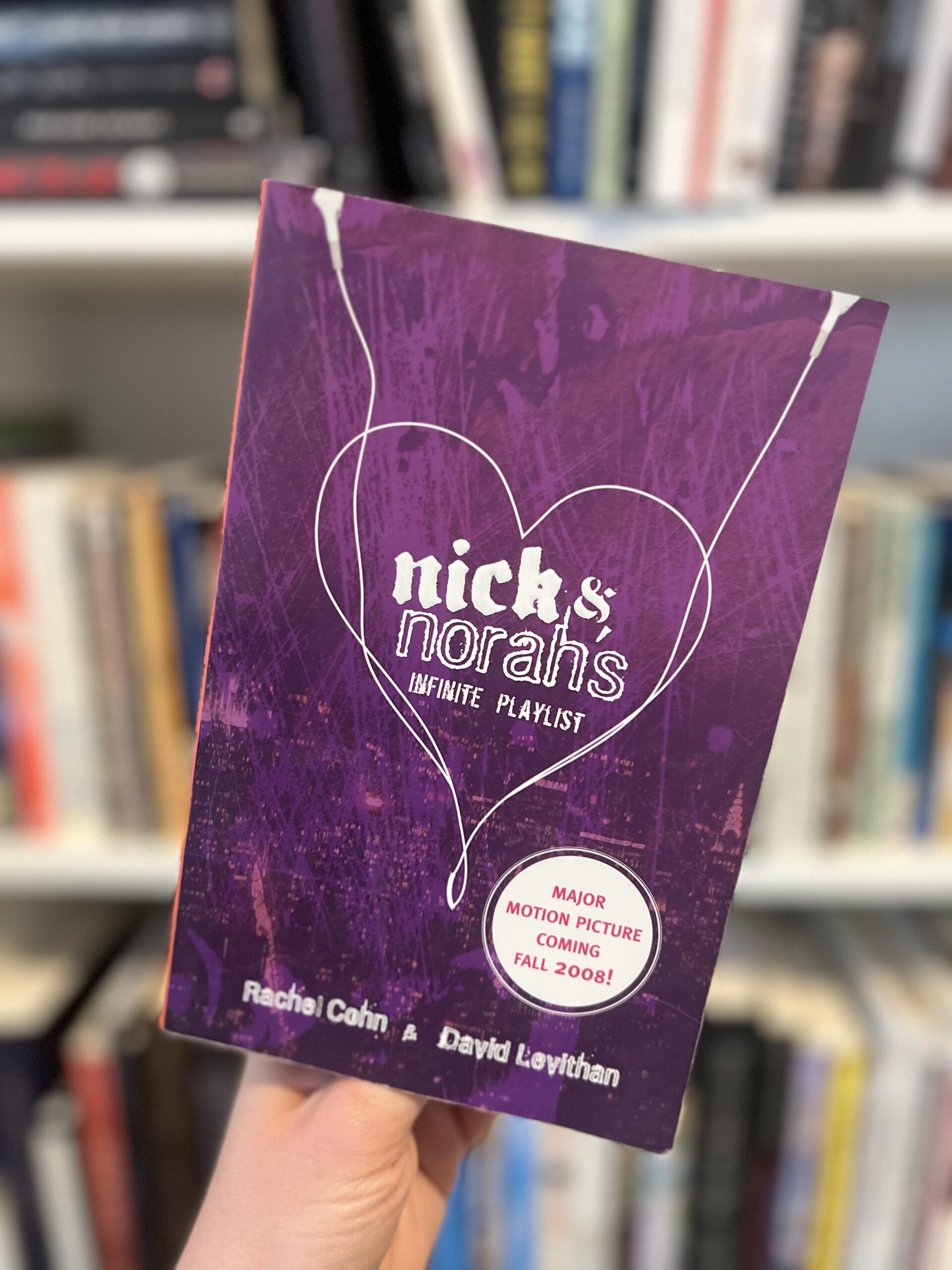
By Rachel Cohn & David Levithan
“Then it hits me.
‘Maybe we’re the pieces,’ I say.’”
Summary
Nick & Norah’s Infinite Playlist centers Nick, a bassist with a hardcore crush on a young woman who is all wrong for him, and Norah, the daughter of a record exec who’s finally discovering her on-again, off-again relationship is toxic. When Nick asks Norah to pretend to be his girlfriend for five minutes to make his crush jealous, Norah goes above and beyond, and the two of them spin out into a single, loud, lovely New York City night.
Quick Info
- Year of Publication: 2007
- Number of Pages: 183
- Awards/Nominations: Cybils Award, ALA Best Books for Young Adults, ALA Quick Picks for Reluctant Young Adult Readers, CCBC Choices
Why I Chose to Read Nick & Norah’s Infinite Playlist
I love music and New York City, and I was hoping to find a YA romance that wasn’t so saccharine.
Teaching Considerations
Audience: Booksellers list this as “14-17 years.” Lots of vulgarity. While I agree that this is a fun romance for this age range, I wonder if the dated musical and pop culture references make it best suited to an older audience… like me!? Hah!
Key Themes: love, music, connection, escaping past relationships, teens who don’t drink or do drugs, Judaism, interfaith, and LGBTQIA+.
Grouping Recommendation: This would be a great student-choice book in a voice, perspective, or romance unit. It’s also brilliantly composed in a way that lends to a potential film adaptation, and can be taught as such.
Instructional Ideas:
CHARACTER/STORY
A masterclass in simplicity, this book is about two characters who help each other escape their romantic pasts and feel out healthier, happier romantic futures.
STRUCTURE
This book was written by two authors, each adopting the perspective of a character (Nick & Norah) and alternating chapters. They move through a chronological, one-day timeline that occasionally, very slightly, overlaps.
Key Excerpts
“I never thought Jessie would betray me like this. I have done nothing but love her and treat her right. I’ve stood by her side and defended her when people called her trash and said they didn’t understand why I kept her. I thought that meant something. But no. Now when I need her most, she’s totally bailed. I turn the key and I turn the key and I turn the key and she doesn’t do a damn thing. How alone am I right now? Even my car has decided to give up on me.” – page 38
How might this car show the difference between Nick and Norah’s lives? Are you sure? How do you know? Do you have a first car/vehicle story? If not, what’s your story?
“So say we’re at the Motel 6 on the other side of the Lincoln Tunnel and we’re having that threeway with E.T. Who gets to be the top and who gets to be the bottom?” – Page 66
The authors of this book are not teenagers. Do you think they’ve nailed the YA voice? Why or why not? Explain your reasoning with examples.
“‘Tikkun olam,’ I repeat.
‘Exactly. Basically, it says that the world has been broken into pieces. All this chaos, all this discord. And our job—everyone’s job—is to try to put the pieces back together. To make things whole again.’” – page 143
Here, Norah uses a Judaic concept to make sense of the world around her. Can you relate? If so, how? If not, what do you use to help you make sense of the world?
Book Talk Excerpt:
“Singing in the rain. I’m singing in the rain. And it’s such a fucking glorious feeling. An unexpected downpour and I am just giving myself into it. Because what the fuck else can you do? Run for cover? Shriek or curse? No—when the rain falls you just let it fall and you grin like a madman and you dance with it, because if you can make yourself happy in the rain then you’re doing pretty alright in life. As the first drops fall, she’s still on the phone and I’m watching her talk and she’s just the most amazingly complicated thing, trying on all these different expressions at once—yelling angry when she’s clearly happy, then pretending to be listening when she’s really watching me and the rain. Then she puts the phone back in Salvatore’s pocket and walks over to me. I don’t know why we say the sky is opening up when it rains—like the sky has been holding back all this time, and then this is its release. And I look at her and she looks at me and it’s like everything just opens up. I am feeling the raindrops drench my clothes. I am feeling the hair fall down in my eyes. But I’m also feeling this lightness and she is so fucking beautiful the way her mouth is uncertain about whether or not to smile. We are on the edge of Times Square with its beacon of lights and we are swaying as the sky is opening, and I reach out for her to be my dance partner and she accepts. So that leaves us on the sidewalk, my arm around her body. She presses close—is just staring at me—and even though I don’t know what the question is, I know the answer. So I say ‘This,’ and I lean in and I kiss her right there on the edge of Times Square, the way people kiss good-bye on the street, only this is more like a hello. This.” – page 156
How do the authors write like music? What have they done here to create formatting that agrees with content? How else do they accomplish this throughout the book?
My Thoughts and Reflections
★★★★★
This was a sweet book, and it reminded me of my “glory days” traipsing around the Lower East Side, listening to live music. Except the characters made much better decisions than I ever did! The character voices weren’t as distinct as I expected, given that two authors worked together on this book. However, I bought the young Jersey couple with similar interests, who were well suited. I’d recommend this to high school ELA students, Millennials, Gen Xers, and anyone looking to write a book that’s perfect for an indie film adaptation.
Topics/Ideas/Books/Authors I’m Curious About As A Result of Reading Nick & Norah’s Infinite Playlist
I’d like to watch the film and compile a list of great YA books with film adaptations!

Leave a Reply