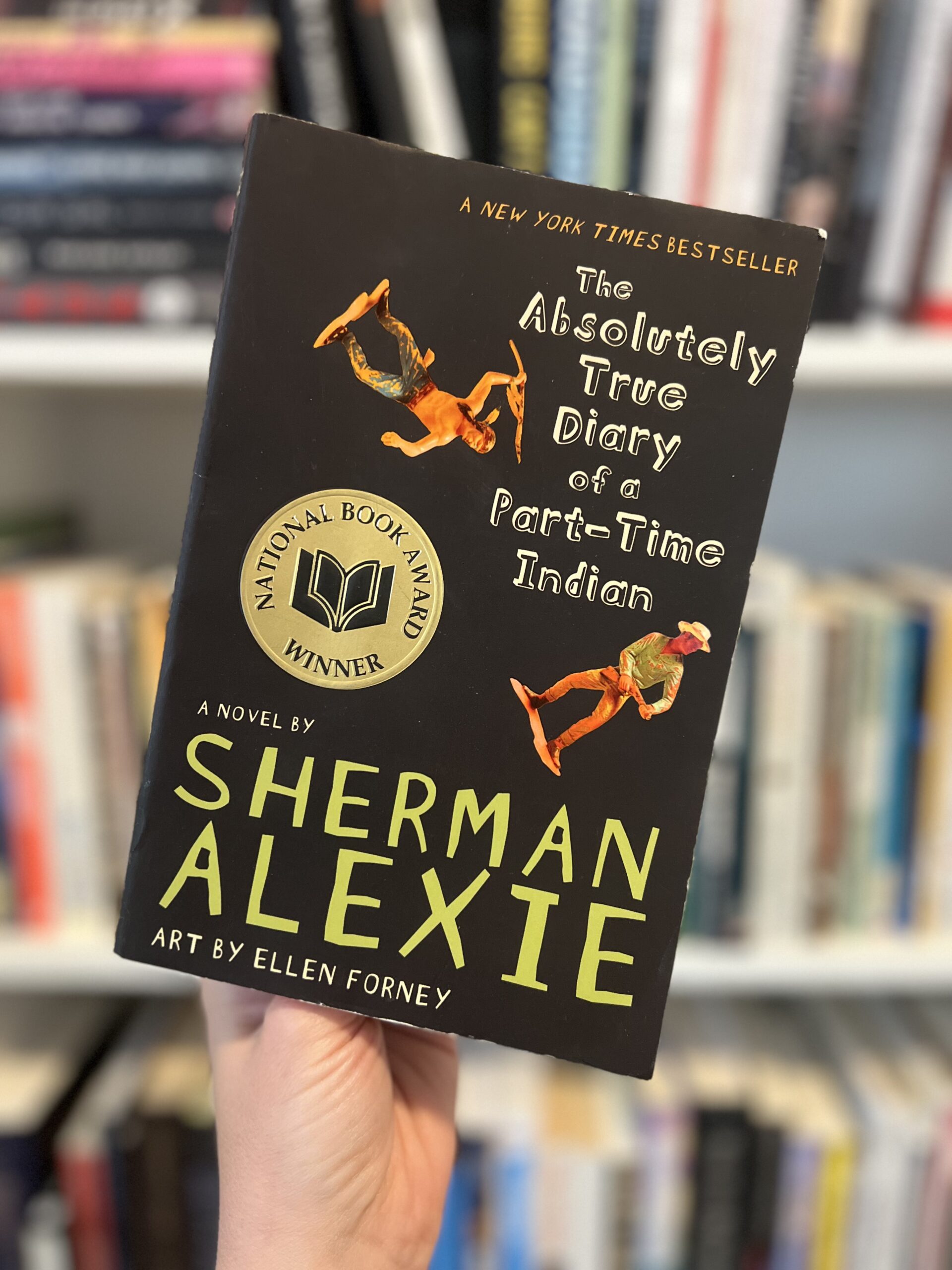
Novel by Sherman Alexie & Illustrations by Ellen Forney
“‘I used to think the world was broken down by tribes,’ I said. ‘By black and white. By Indian and white. But I know that isn’t true. The world is only broken into two tribes: The people who are assholes and the people who are not.’”
Summary
A Native American basketball-playing teenager named Arnold Spirit Jr. (“Junior”) chooses to leave his school on the Spokane Indian Reservation to attend a mostly white high school in a nearby town. This strains his friendship with his best friend, Rowdy, and forces him to navigate two different worlds and find himself.
Quick Info
- Year of Publication: 2007
- Number of Pages: 288
- Awards/Nominations: National Book Award, Boston Globe-Horn Book Award, American Library Association (ALA) Best Book for Young Adults, Odyssey Award: Best Audiobook for Children or Young Adults, California Young Reader Medal
Why I Chose to Read The Absolutely True Diary of a Part-Time Indian
My father was a member of the American Indian Movement when I was a kid, and I would go to events and attend rallies with him, so I’ve long been aware of injustices faced by indigenous populations during and in the aftermath of colonization. I’m committed to advocating for all my students and encouraging them to listen to diverse perspectives. I was also hoping to find a healthy dose of the humor so many AIM members wielded.
Teaching Considerations
Audience: Booksellers list this as “7+.” This is the best age range I’ve ever seen for any YA book. (Yes, I believe in “start ’em young!”) Thrilled to see publishers trusting kids with this one.
Key Themes: Identity, poverty, inequality, being American, friendship, family, loyalty, racism, community, grief, sobriety, resilience, and self-determination.
Grouping Recommendation: This would be great for a full class or for book club reading. I’d also recommend it to any student who feels othered, loves basketball and/or art, or gets bullied.
Instructional Ideas:
VOICE
This book is a legendary example of learning all the rules about writing and then breaking them exquisitely. Junior’s unique voice and perspective are thoughtfully, powerfully crafted.
STORY
The heart of this book is in the Junior-Rowdy friendship. Both boys are poor. Both boys are Native American and live on the rez. Both boys play basketball. Both boys have parents struggling with alcoholism. But only Rowdy has an abusive father, who seemingly has no drive to do and be better. And only Junior decides to defy community norms, learn, and thrive on his own terms.
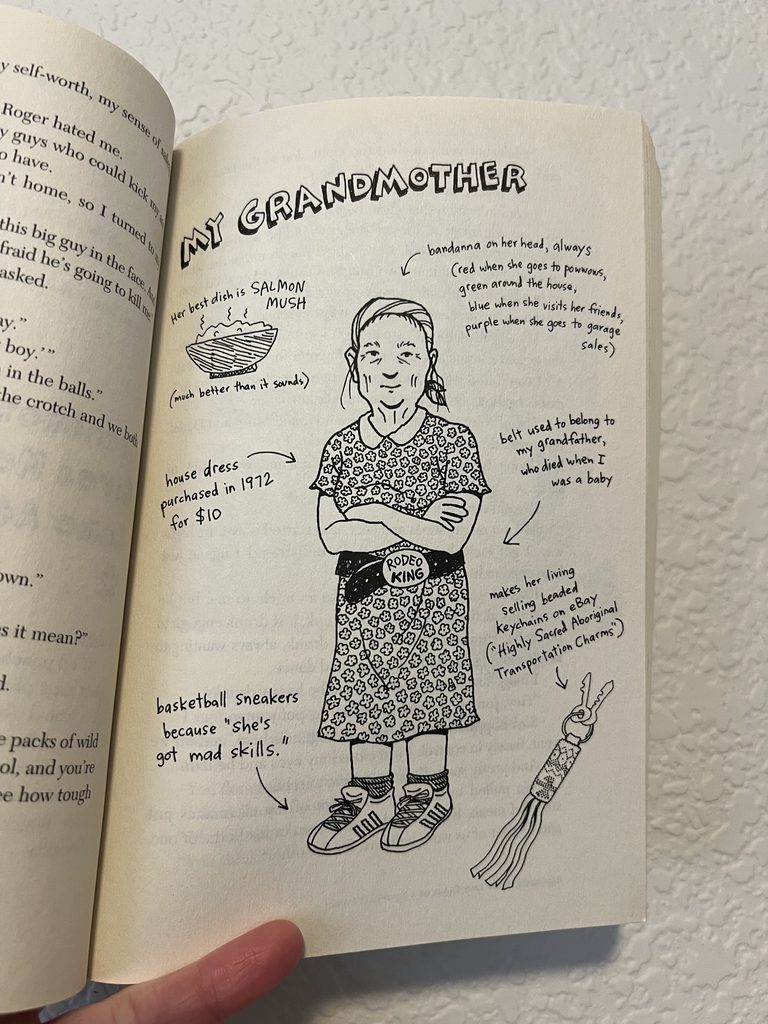
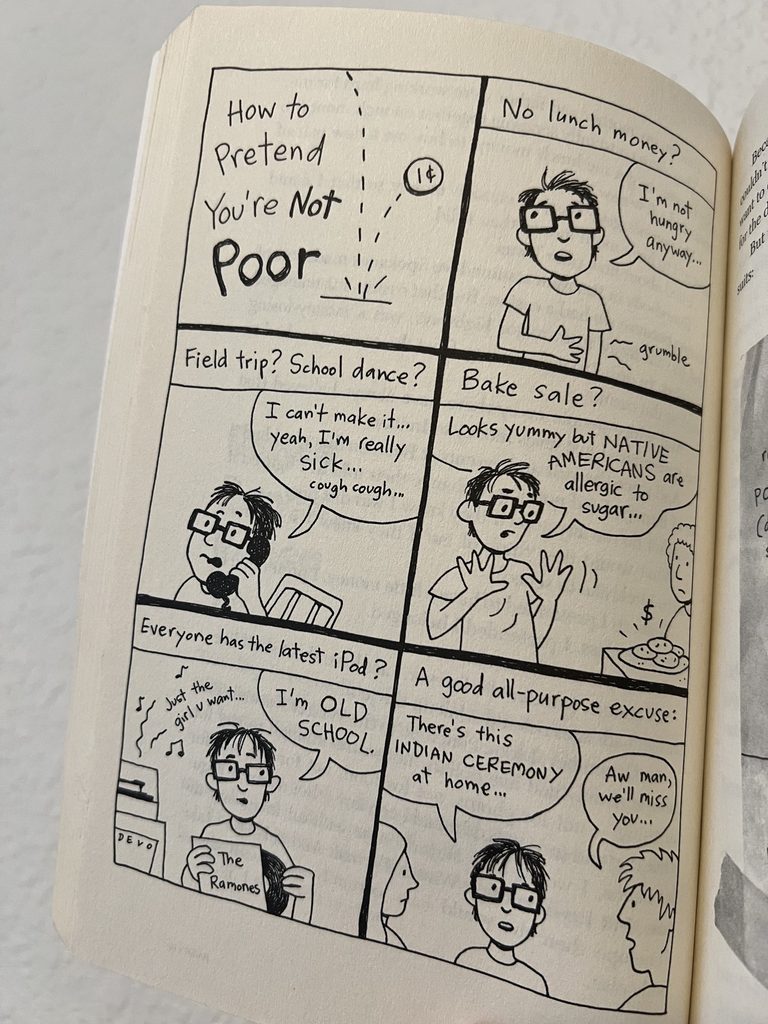
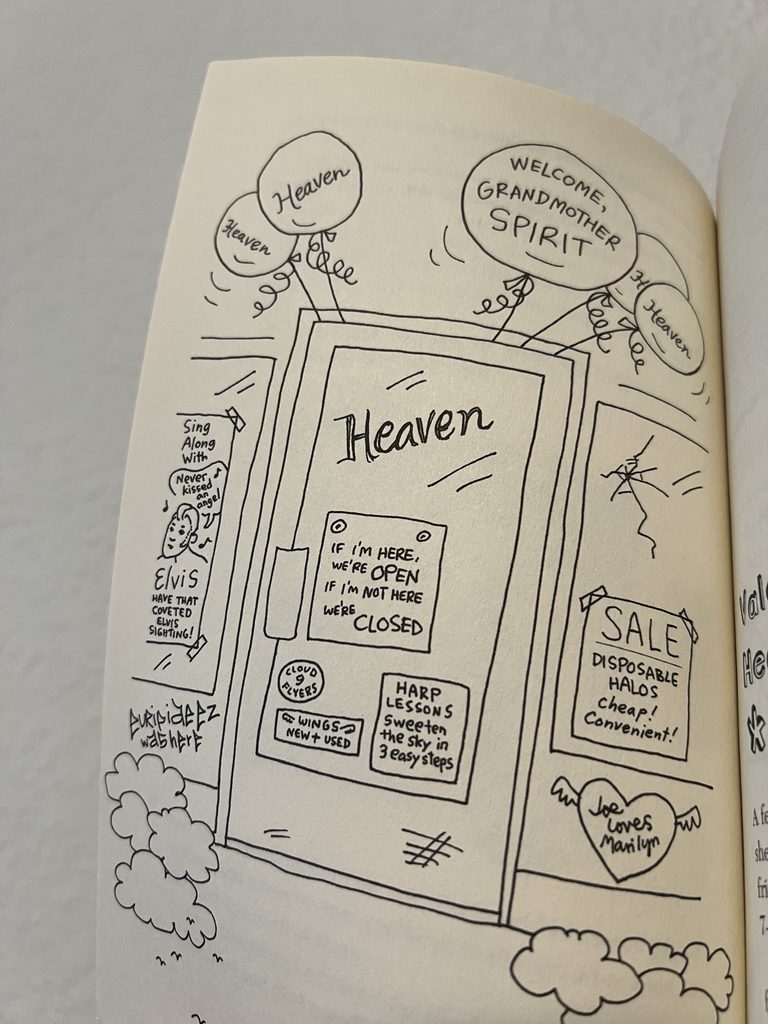
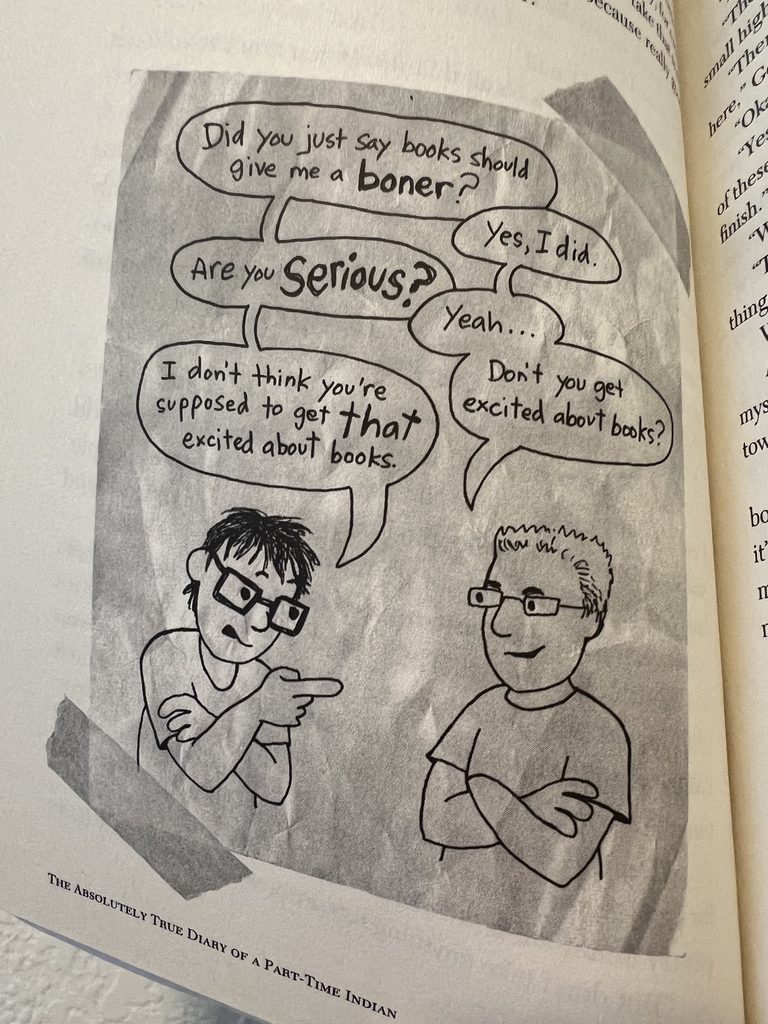
ILLUSTRATIONS
Here are a few of my favorite drawings:
Key Excerpts
“Poverty doesn’t give you strength or teach you lessons about perseverance. No, poverty only teaches you how to be poor.” – page 13
What effect does Junior’s economic status have on this story? Is it integral? Is it insightful? Is it something else? How do you know?
“‘I can do it,’ I said to Coach, to my teammates, to the world.
‘You can do it,’ Coach said.
‘I can do it.’
‘You can do it.’
‘I can do it.’
Do you understand how amazing it is to hear that from an adult? Do you know how amazing it is to hear that from anybody? It’s one of the simplest sentences in the world, just four words, but they’re the four hugest words in the world when they’re put together.” – page 189
Pick a sentence, five words or less, that means the world to you. (It can be the same as Junior’s!) What is it? Why is it so important to you?
Book Talk Excerpt:
“I was born with water on the brain.
Okay, so that’s not exactly true. I was actually born with too much cerebral spinal fluid inside my skull. But cerebral spinal fluid is just the doctors’ fancy way of saying brain grease. And brain grease works inside the lobes like car grease works inside an engine. It keeps things running smooth and fast. But weirdo me, I was born with too much grease inside my skull, and it got all thick and muddy and disgusting, and it only mucked up the works. My thinking and breathing and living engine slowed down and flooded.
My brain was drowning in grease.
But that makes the whole thing sound weirdo and funny, like my brain was a giant French fry, so it seems more serious and poetic and accurate to say, ‘I was born with water on the brain.’
Okay, so maybe that’s not a very serious way to say it, either. Maybe the whole thing is weird and funny.
But jeez, did my mother and father and big sister and grandma and cousins and aunts and uncles think it was funny when the doctors cut open my little skull and sucked out all that extra water with some tiny vacuum?
I was only six months old and I was supposed to croak during the surgery. And even if I somehow survived the mini-Hoover, I was supposed to suffer serious brain damage during the procedure and live the rest of my life as a vegetable.
Well, I obviously survived the surgery. I wouldn’t be writing this if I didn’t, but I have all sorts of physical problems that are directly the result of my brain damage.
First of all, I ended up having forty-two teeth. The typical human has thirty-two, right? But I had forty-two.
Ten more than usual.
Ten more than normal.
Ten teeth past human.
My teeth got so crowded that I could barely close my mouth. I went to Indian Health Service to get some teeth pulled so I could eat normally, not like some slobbering vulture. But the Indian Health Service funded major dental work only once a year, so I had to have all ten extra teeth pulled in one day.
And what’s more, our white dentist believed that the Indians only felt half as much pain as white people did, so he only gave me half the Novocain.
What a bastard, huh?
Indian Health Service also funded eyeglass purchases only once a year and offered one style: those ugly, thick, black plastic ones.
My brain damage left me nearsighted in one eye and farsighted in the other, so my ugly glasses were all lopsided because my eyes were so lopsided.
I get headaches because my eyes are, like, enemies, you know, like they used to be married to each other but now hate each other’s guts.
And I started wearing glasses when I was three, so I ran around the rez looking like a three-year-old Indian grandpa.
And, oh, I was skinny. I’d turn sideways and disappear.
But my hands and feet were huge. My feet were a size eleven in third grade! With my big feet and pencil body, I looked like a capital L walking down the road.
And my skull was enormous.
Epic.
My head was so big that little Indian skulls orbited around it. Some of the kids called me Orbit. And other kids just called me Globe. The bullies would pick me up, spin me in circles, put their finger down on my skull, and say, ‘I want to go there.’
So obviously, I looked goofy on the outside, but it was the inside stuff that’s the worst.” – page 1-3
Do you think the author did a good job opening this book? Why or why not? What components do you believe are key to creating a compelling beginning?
My Thoughts and Reflections
★★★★★
I knew I was going to love this story almost instantaneously. I started with the audiobook, then switched to the paperback when life allowed. I was delighted when I realized there were illustrations! Alexie’s voice is so powerful. He writes with such ease and authority. He’ll make you want to laugh and cry multiple times on the same page. I could not stop reading this truly brilliant underdog story, and I’d recommend it in a heartbeat.
Topics/Ideas/Books/Authors I’m Curious About As A Result of Reading The Absolutely True Diary of a Part-Time Indian
I’d like to read and reread the works of the American Indian Movement leaders I looked up to as a kid: Clyde Bellecourt, Dennis Banks, Glenn Morris, Russell Means, Winona LaDuke, and Ward Churchill.

Leave a Reply